

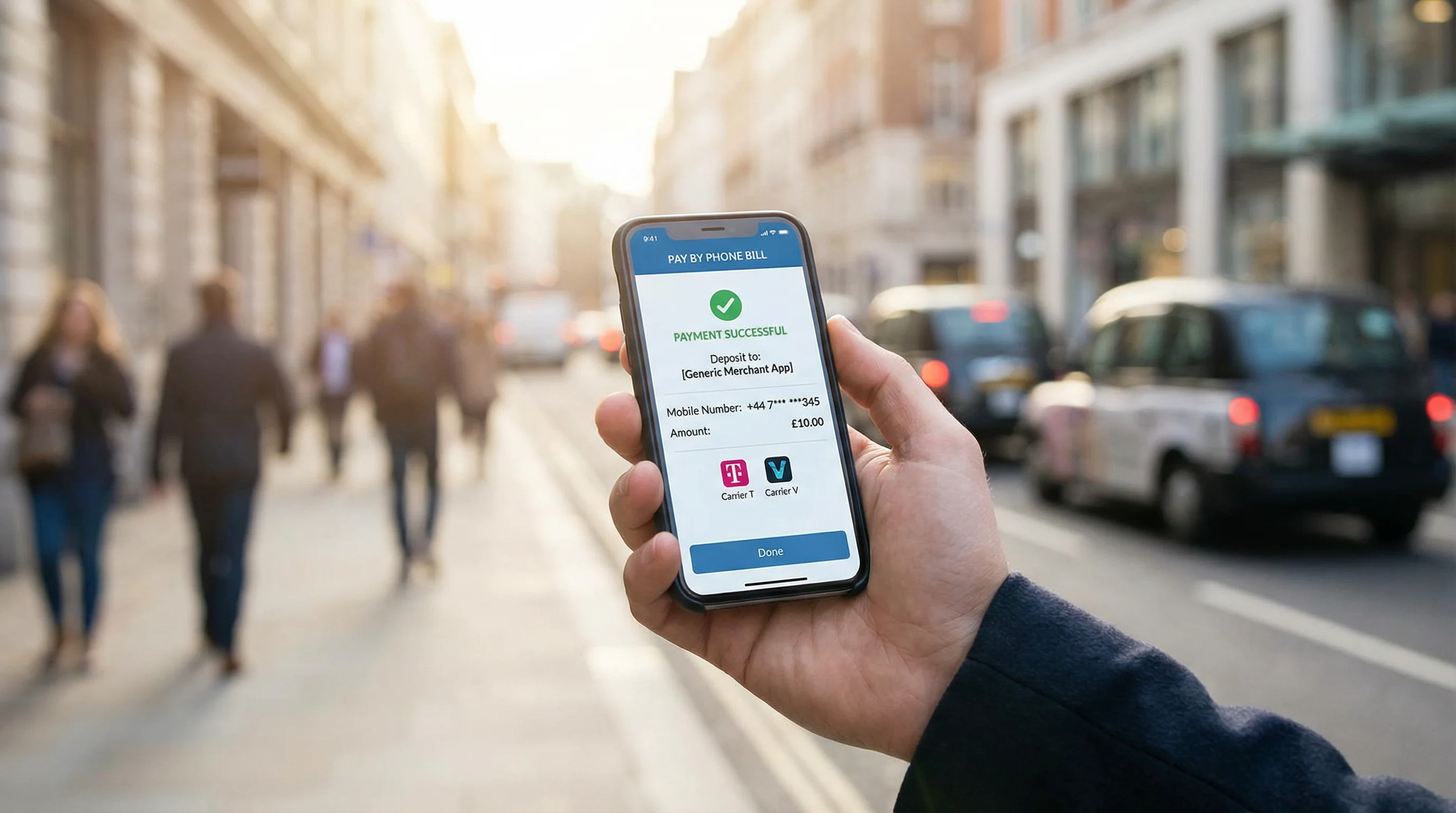
Pay by Mobile: Deposit via Phone Bill
Your phone bill becomes your deposit method. Pay by Mobile—also known as carrier billing or phone bill deposits—allows casino app funding without entering bank details, card numbers, or e-wallet credentials. The deposit amount simply appears on your next phone bill or deducts from prepaid credit. For players seeking payment simplicity, this method offers unique convenience.
The technology works through partnerships between casino payment processors and mobile network operators. When you select Pay by Mobile, the casino communicates with your carrier to verify your number and request charge authorisation. You confirm via text message or in-app prompt, and funds credit to your casino account. The carrier later collects payment through your standard billing relationship.
UK adoption of Pay by Mobile has grown significantly as players recognise its advantages for certain use cases. Not sharing banking information with casinos appeals to privacy-conscious players. The method’s simplicity suits those finding card or e-wallet payments cumbersome. And the near-instant crediting matches player expectations for deposit speed in 2026.
However, Pay by Mobile carries constraints that make it unsuitable as a primary deposit method for most serious players. Low limits, inability to withdraw, and carrier-specific availability restrict its practical utility. Understanding both the advantages and limitations helps determine whether Pay by Mobile suits your needs or whether alternative methods serve you better.
How Pay by Mobile Works
From text confirmation to casino credit. The Pay by Mobile process involves several steps that typically complete within moments, though understanding the underlying mechanics helps troubleshoot when issues arise.
Initiating a deposit begins by selecting Pay by Mobile from the casino app’s payment options. You’ll enter your UK mobile number and the deposit amount—typically within tight limits ranging from £10 to £30 per transaction. The app transmits this request to a payment processor that specialises in carrier billing.
Payment processors like Boku and Payforit handle the communication between casinos and mobile carriers. These intermediaries maintain technical integrations with UK networks and manage the authentication, charging, and settlement processes. Boku, founded in 2009 and listed on the London Stock Exchange, processes billions in transactions annually. Casino apps contract with these processors rather than integrating directly with each carrier, simplifying the technical implementation.
Carrier verification occurs after you submit your deposit request. The payment processor contacts your mobile network to confirm your number exists, your account is in good standing, and you haven’t exceeded daily or monthly limits. This verification happens automatically, typically within seconds, though network congestion can occasionally cause delays.
Confirmation requests arrive via text message or through in-app prompts. You’ll receive a message asking you to authorise the specific charge amount to your phone bill. Replying “yes” or confirming in-app completes the authorisation. This step ensures you consciously approve each charge rather than having deposits processed automatically.
Funds credit to your casino account immediately upon confirmation. Unlike bank transfers that might take hours, Pay by Mobile deposits typically appear within seconds of confirmation. You can begin playing immediately, making this method genuinely instant despite the multiple background steps involved.
Billing occurs through your standard phone bill cycle. If you’re on a monthly contract, the casino deposit appears as a line item on your next bill alongside call charges and data fees. Prepaid customers see credit deducted immediately from their balance. Either way, you’re not charged until after the casino has already credited your deposit.
Daily and monthly limits apply across all Pay by Mobile transactions, not per casino. Carrier-imposed caps, regulated by Ofcom (which took over from the Phone-paid Services Authority in February 2025), typically restrict daily deposits to £30-£40 and monthly deposits to £240, though exact limits vary by carrier. Reaching these limits blocks further Pay by Mobile deposits until limits reset, regardless of which casino you’re attempting to deposit at.
Transaction records appear on your phone bill with merchant identifiers that may or may not clearly indicate casino activity. Some carriers display “Boku” or “Payforit” as the merchant name rather than specific casino brands. This provides modest privacy but also means bill recipients might not immediately recognise what charges represent.
Best Pay by Mobile Casino Apps
Where Pay by Mobile works. Most major UK casino apps support Pay by Mobile deposits, though implementation details and promoted visibility vary. The best apps for this payment method make it easy to find and use while supporting all major UK carriers.
Leading bookmaker-casino brands typically offer Pay by Mobile alongside their extensive payment method ranges. These operators have established relationships with payment processors and technical infrastructure already handling high transaction volumes. Pay by Mobile functions smoothly at these apps because the operators have invested in proper integration rather than treating it as an afterthought.
Pure-play casino apps also commonly support carrier billing, recognising that some players specifically prefer this method. Newer apps particularly tend toward comprehensive payment option coverage as part of their market positioning. Checking payment method lists before registering confirms Pay by Mobile availability at specific apps you’re considering.
Promotional eligibility sometimes differs for Pay by Mobile deposits. Some casinos exclude carrier billing deposits from welcome bonus eligibility or offer reduced bonuses for these deposits. The reasoning relates to fraud prevention—Pay by Mobile’s low verification requirements create higher chargeback risks that casinos offset through promotional restrictions. Verifying bonus terms before choosing this deposit method prevents disappointment.
Carrier coverage varies between apps depending on which payment processors they’ve integrated. An app using Boku might support different carriers than one using Payforit or alternative processors. If your carrier isn’t supported at a particular app, the Pay by Mobile option either won’t appear or will display an error when you attempt the deposit. Testing compatibility before committing to a specific app as your Pay by Mobile destination makes sense.
Transaction limits may differ between casinos even when using the same carrier. While carriers impose their own limits, individual casinos sometimes set lower per-transaction or daily caps. An app limiting Pay by Mobile deposits to £20 each provides less utility than one allowing the full carrier limit. These casino-specific limits aren’t always prominently displayed, sometimes requiring deposit attempts to discover actual limits.
Best casino sites in the UK
- BeOnBetBonus: 100% up to €500 + 100 FS · Payout speed: 1-3 business days
- NightLuckBonus: Welcome Pack + 805% Up To 6400€ + 280 FS · Payout speed: 1-3 business days
- AmunbetBonus: Join now and get 450% up to 2,700 GBP + 450 FS · Payout speed: 1-3 business days
- JetsetspinsBonus: 200% Bonus + 100 Free Spins + Free Royal Wheel · Payout speed: 1-3 business days
- x3betBonus: Welcome Pack 100% Up to £1.000 + 200 Free Spins · Payout speed: 1-3 business days
- SpinFormulaBonus: 550% Up To £15,000 + 550 FS · Payout speed: 1-3 business days
- EvoSpinBonus: 125% up to €2500 + 125 Free Spins · Payout speed: 1-3 business days
- ChanzeBonus: Slots Welcome Bonus #1 200% up to €500 · Payout speed: 1-3 business days
- SlotoSportBonus: 500% up to £ 10 200+ 777 FS · Payout speed: 1-3 business days
- Revery PlayBonus: 100% up to€1,000+ 100 FS · Payout speed: 1-3 business days
Advantages and Limitations
Convenient with clear constraints. Pay by Mobile suits specific use cases exceptionally well while being entirely inappropriate for others. Understanding the trade-offs helps determine whether this method fits your needs.
No banking information sharing provides meaningful privacy advantage. Your card numbers, bank account details, and e-wallet credentials never reach the casino. If the casino suffered a data breach, your financial information wouldn’t be exposed because they never had it. For privacy-conscious players, this isolation provides genuine comfort.
Instant deposits with minimal friction appeal to players wanting to play immediately without navigating complex payment processes. Enter your phone number, confirm via text, and you’re funded. The simplicity surpasses most alternative methods, particularly for small deposits where extensive verification feels disproportionate.
Low deposit limits represent the primary limitation. Carrier-imposed caps around £30-£40 per day and £240 per month restrict Pay by Mobile to supplementary or recreational use. Players with larger bankrolls cannot rely on carrier billing as their main funding method—the limits simply don’t accommodate substantial deposits.
No withdrawal capability means funds deposited via Pay by Mobile must be withdrawn through alternative methods. You cannot receive casino winnings to your phone bill; that’s not how carrier billing works. This requires maintaining at least one withdrawal-capable payment method regardless of how you prefer to deposit. The asymmetry complicates the payment experience for players who chose Pay by Mobile specifically to avoid other methods.
Higher effective costs sometimes apply through Pay by Mobile. Some payment processors charge fees that casinos may pass along, and the deposits appear on phone bills that typically don’t offer the same consumer protections as card transactions. The convenience has costs beyond the obvious.
Bill surprises affect players who don’t track their deposits carefully. Phone bill charges arriving weeks after deposits sometimes catch players unaware, particularly those who made multiple small deposits that accumulated to surprising totals. The delayed billing creates budgeting challenges that immediate payment methods avoid.
UK Carrier Support
Which networks work where. Major UK mobile carriers support Pay by Mobile casino deposits, though availability varies by specific casino and payment processor integration.
EE supports carrier billing through most payment processors used by UK casinos. As the UK’s largest mobile network, EE compatibility is typically prioritised by casinos implementing Pay by Mobile. Both contract and pay-as-you-go EE customers can use this deposit method, subject to standard carrier limits and account standing requirements.
Vodafone provides broad Pay by Mobile support across UK casino apps. The network’s carrier billing service works with major payment processors, making Vodafone numbers usable at most casinos offering this deposit method. Account-level restrictions might apply for customers with payment issues or newly activated accounts.
Three coverage depends more heavily on which payment processor specific casinos use. Some processors have stronger Three integration than others, meaning availability can be inconsistent between apps. Testing whether your Three number works at specific casinos before committing helps avoid frustration.
O2 customers generally find good Pay by Mobile support, though the network has historically had tighter restrictions on gambling-related carrier billing. O2’s approach to responsible gambling includes limits and controls that may affect Pay by Mobile availability or functionality for some customers.
MVNO and smaller carrier support varies significantly. Virtual network operators like Giffgaff, Tesco Mobile, and others depend on their underlying network agreements for carrier billing functionality. Some MVNOs fully support Pay by Mobile; others have limited or no gambling-related carrier billing. Checking specific compatibility for less common carriers requires either contacting your provider or attempting small test deposits.
When Pay by Mobile Isn’t Available
Other options for quick deposits. When Pay by Mobile doesn’t suit your needs—whether due to carrier incompatibility, limit constraints, or withdrawal requirements—several alternative methods provide comparable convenience.
E-wallets like PayPal, Skrill, and Neteller offer instant deposits without sharing card details directly with casinos. They require initial setup and funding, but once established, they provide fast deposits with higher limits than carrier billing. Unlike Pay by Mobile, e-wallets support both deposits and withdrawals, making them more complete payment solutions.
Debit card deposits process quickly at most UK casinos, often crediting instantly. While this requires sharing card information, UK gambling regulations mandate security standards that protect card data. For players comfortable with card payments, this remains the most straightforward deposit method with no practical upper limits.
Trustly and similar bank-direct services enable instant deposits without card numbers by connecting directly to your bank account through secure authorisation. The speed matches Pay by Mobile while supporting larger amounts and, at some casinos, direct withdrawals to your bank account.
Apple Pay and Google Pay provide mobile-native payment experiences that feel similarly convenient to Pay by Mobile while using existing card or bank connections. Availability at UK casino apps continues expanding, offering biometric-authenticated deposits that combine security with speed.
Prepaid cards purchased with cash provide maximum privacy for players concerned about gambling transactions appearing in financial records. These require purchasing physical or virtual cards separately, then using those cards for casino deposits. The extra step reduces convenience but provides transaction isolation that even Pay by Mobile can’t match.
For payment options visit realmoneycasinoandroid. See the full breakdown in our casino app payments.