

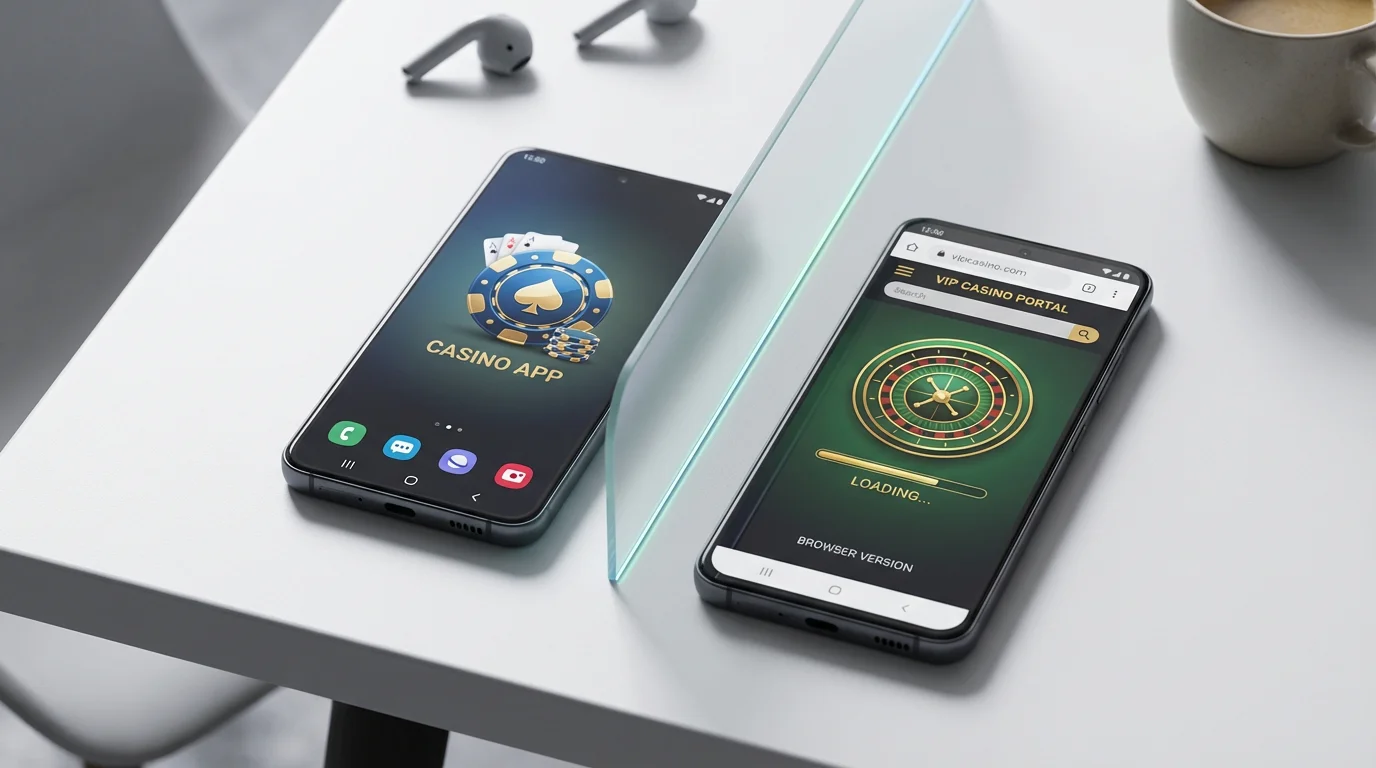
Native Apps vs Browser: The Real Differences
Both get you playing—but they’re not identical. UK casino players can access their accounts through dedicated Android apps or mobile browsers visiting the same casino websites. Both approaches deliver fundamentally similar gambling experiences, yet meaningful differences exist in performance, convenience, and feature availability that make one option preferable depending on your circumstances.
HTML5 technology has narrowed the gap considerably. Modern browser-based casino games run on the same underlying technology as their native app counterparts, eliminating the dramatic quality differences that once distinguished these approaches. A slot spinning in Chrome performs comparably to the same slot in a dedicated app, with visual quality and gameplay mechanics essentially identical. Since Adobe discontinued Flash support in 2020, HTML5 has become the universal standard for online casino games, enabling seamless cross-platform compatibility.
The differences that remain relate more to surrounding features than core gaming. How you log in, how you receive notifications, how quickly the platform loads, and how much storage space you sacrifice—these peripheral factors distinguish app play from browser play more than the gambling experience itself.
Neither option is universally superior. The right choice depends on how frequently you play, how many casinos you use, your device’s storage constraints, and your preferences regarding convenience versus flexibility. Understanding what each approach offers helps match your access method to your playing patterns.
Best casino sites in the UK
- BeOnBetBonus: 100% up to €500 + 100 FS · Payout speed: 1-3 business days
- NightLuckBonus: Welcome Pack + 805% Up To 6400€ + 280 FS · Payout speed: 1-3 business days
- AmunbetBonus: Join now and get 450% up to 2,700 GBP + 450 FS · Payout speed: 1-3 business days
- JetsetspinsBonus: 200% Bonus + 100 Free Spins + Free Royal Wheel · Payout speed: 1-3 business days
- x3betBonus: Welcome Pack 100% Up to £1.000 + 200 Free Spins · Payout speed: 1-3 business days
- SpinFormulaBonus: 550% Up To £15,000 + 550 FS · Payout speed: 1-3 business days
- EvoSpinBonus: 125% up to €2500 + 125 Free Spins · Payout speed: 1-3 business days
- ChanzeBonus: Slots Welcome Bonus #1 200% up to €500 · Payout speed: 1-3 business days
- SlotoSportBonus: 500% up to £ 10 200+ 777 FS · Payout speed: 1-3 business days
- Revery PlayBonus: 100% up to€1,000+ 100 FS · Payout speed: 1-3 business days
Why Use a Native Casino App
What downloading gets you. Native apps installed on your device provide certain conveniences and performance characteristics that browser play cannot fully replicate.
Launch speed represents the most noticeable native app advantage. Tapping an app icon loads the casino interface faster than navigating to a website through a browser, entering URLs, and waiting for page renders. For frequent players, these seconds saved per session accumulate into meaningful convenience over time.
Biometric login through fingerprint or face recognition streamlines authentication. Native apps can integrate with Android’s biometric systems, allowing secure login without typing passwords. Browser-based play requires manual credential entry or password manager interaction—functional but less elegant than biometric one-touch access.
Push notifications keep players informed about bonuses, promotions, and account activity. Apps can send alerts even when not actively in use, ensuring you don’t miss time-limited offers or important account information. Browser play lacks this persistent notification capability unless you specifically enable browser notifications, which most users don’t.
Performance optimisation in well-built native apps can exceed browser equivalents. Apps designed specifically for Android can leverage device capabilities more efficiently than browser-based solutions constrained by web standards. This advantage varies by app quality—some native apps perform excellently while others offer no improvement over browsers.
Offline functionality, while limited for gambling apps, does exist in some forms. Certain apps allow browsing game libraries, checking account information, or reviewing terms while offline. Actual gambling requires internet connectivity regardless of access method, but peripheral features may work without constant connection in native apps.
Home screen presence serves as a reminder and quick-access point. An app icon among your other applications provides instant visibility and one-tap access that bookmarked websites don’t quite match. For regular players, this presence integrates casino access into normal phone usage patterns.
Why Use Mobile Browser Play
What staying in browser offers. Browser-based casino access provides advantages that native apps cannot match, particularly for players using multiple casinos or managing device storage carefully.
No download or installation means immediate play at any casino. Visiting a mobile-optimised casino website provides instant access without waiting for downloads, agreeing to installation prompts, or consuming storage space. For trying new casinos or occasional play at multiple sites, browser access proves more practical than maintaining numerous installed apps.
Storage savings matter on devices with limited capacity. Native casino apps typically consume 50-200 megabytes each, with some exceeding these figures. Players active at multiple casinos might dedicate gigabytes to casino apps alone. Browser play requires only the storage for the browser itself, which you likely have installed regardless.
Instant updates occur automatically with browser play. When casinos modify their platforms, browser users see changes immediately upon their next visit. Native app users must download and install updates, sometimes waiting for app store approval processes that delay new feature access. Browser play ensures you always access the current platform version.
Universal access across devices follows naturally from browser-based play. Your login works identically on any device with a web browser—phones, tablets, computers, even smart TVs in some cases. Native apps tie you to specific platforms and require separate installation on each device you use.
Privacy considerations favour browser play for some users. Browser history and cached data can be cleared easily, leaving minimal traces of casino activity. Installed apps remain visible in application lists and cannot be as easily concealed. Players preferring discretion may find browser access more suitable.
Avoiding app store restrictions benefits UK players accessing certain casinos. Google Play’s gambling app policies affect which casinos can distribute through official channels. While Google Play permits real-money gambling apps in the UK for properly licensed operators, the approval process can be lengthy, meaning some legitimate casinos distribute apps directly. Browser access bypasses these restrictions entirely, providing the same experience regardless of app store availability.
Feature-by-Feature Comparison
Side by side assessment. Comparing specific features clarifies where each approach excels and where they perform equivalently.
Game selection typically matches between app and browser at the same casino. The HTML5 games work identically across both access methods, with the same titles, RTPs, and features available regardless of how you reach them. Occasional exceptions exist where specific games might not render properly on one platform, but these are rare and usually temporary.
Login convenience favours native apps through biometric authentication. Browser login requires typing or password manager interaction; app login can work with fingerprint or face recognition. The difference amounts to seconds per session but contributes to overall experience quality.
Loading performance varies by implementation quality rather than inherent platform advantage. Well-optimised apps load faster than poorly optimised ones; well-built mobile websites outperform clunky apps. Generally, native apps hold slight speed advantages, but exceptions exist frequently enough that generalisation becomes unreliable.
Notification capabilities strongly favour native apps. Push notifications provide proactive communication that browser play cannot replicate effectively. Players relying on bonus notifications to catch time-sensitive offers benefit meaningfully from app installation.
Storage impact exclusively affects native app users. Browser play consumes no dedicated storage beyond temporary cache files automatically managed by the browser. Apps require permanent storage allocation that grows with updates and accumulated data.
Multi-casino management favours browser play. Switching between casinos in a browser requires only navigating to different URLs. With apps, switching means exiting one app and launching another. For players active at multiple casinos during single sessions, browser play provides more fluid transitions.
Security implementation should be equivalent between methods. UKGC licensing requirements mandate security standards regardless of access method. Both apps and mobile websites must protect player data and transactions to regulatory standards. Theoretical security differences exist, but practical protection levels should match at properly regulated casinos.
When to Use Each Option
The right choice depends on how you play. Different playing patterns and priorities point toward different access methods.
Choose native apps if you play frequently at one or two primary casinos. The convenience features—quick launch, biometric login, notifications—provide cumulative benefits that justify storage allocation when you use the apps regularly. Installing apps for casinos you visit weekly makes sense; installing them for casinos you visit monthly probably doesn’t.
Choose browser play if you spread activity across many casinos. Maintaining apps for five or ten different casinos consumes storage without proportional benefit when no single app sees heavy use. Browser play accommodates promiscuous casino exploration more practically than app collection.
Choose native apps if bonus notifications matter to your strategy. Players who act quickly on time-limited promotions benefit from push notifications that alert them to opportunities. Missing a six-hour bonus window because you didn’t happen to check the website costs real value that notifications would preserve.
Choose browser play if device storage is constrained. Older devices or those filled with other apps and media may not comfortably accommodate multiple casino applications. Browser play provides full casino access without demanding dedicated storage space.
Choose either method based on personal preference if none of the above factors apply strongly. For casual players without strong constraints, both approaches work adequately. The differences are real but not dramatic enough to override simple preference for one approach over the other.
PWAs: The Middle Ground
App-like without the download. Progressive Web Apps occupy a middle position between native apps and pure browser play, offering some benefits of each approach.
PWAs are essentially bookmarks with enhanced capabilities. When a mobile website supports PWA functionality, you can “install” it to your home screen through browser options. The resulting icon looks and behaves somewhat like a native app—launching opens the casino directly rather than through visible browser interface—while remaining a web-based solution technically.
Installing a PWA from Chrome involves visiting the casino’s mobile site, tapping the browser menu, and selecting “Add to Home Screen” or “Install App.” The process takes seconds and creates an app-like shortcut without the storage consumption of true native apps. Some casinos prompt this installation automatically when they detect mobile browser visits.
PWA capabilities vary by casino implementation. Well-implemented PWAs can offer features approaching native apps: offline browsing of certain content, home screen presence, full-screen display without browser chrome. Less developed PWAs amount to little more than glorified bookmarks. Testing specific casino PWAs reveals how much they truly enhance the browser experience.
The practical benefit of PWAs lies in quick-access convenience without storage sacrifice. You get the home screen icon and one-tap launch of native apps while retaining the storage efficiency and automatic updates of browser play. For players wanting app-like experience at multiple casinos without dedicating gigabytes to installations, PWAs offer sensible compromise.
Notification support in PWAs has improved significantly. Modern PWAs can support push notifications on Android and desktop browsers, and since iOS 16.4, Apple also supports web push notifications for PWAs installed to the Home Screen. However, coverage remains spottier than native app notifications, and iOS users must actively install the PWA to their device before receiving notifications. Don’t assume a PWA will deliver the notification benefits of true native apps without testing.
Learn which option suits you at realmoneycasinoandroid. Then follow our guide on how to download casino apps on Android.