

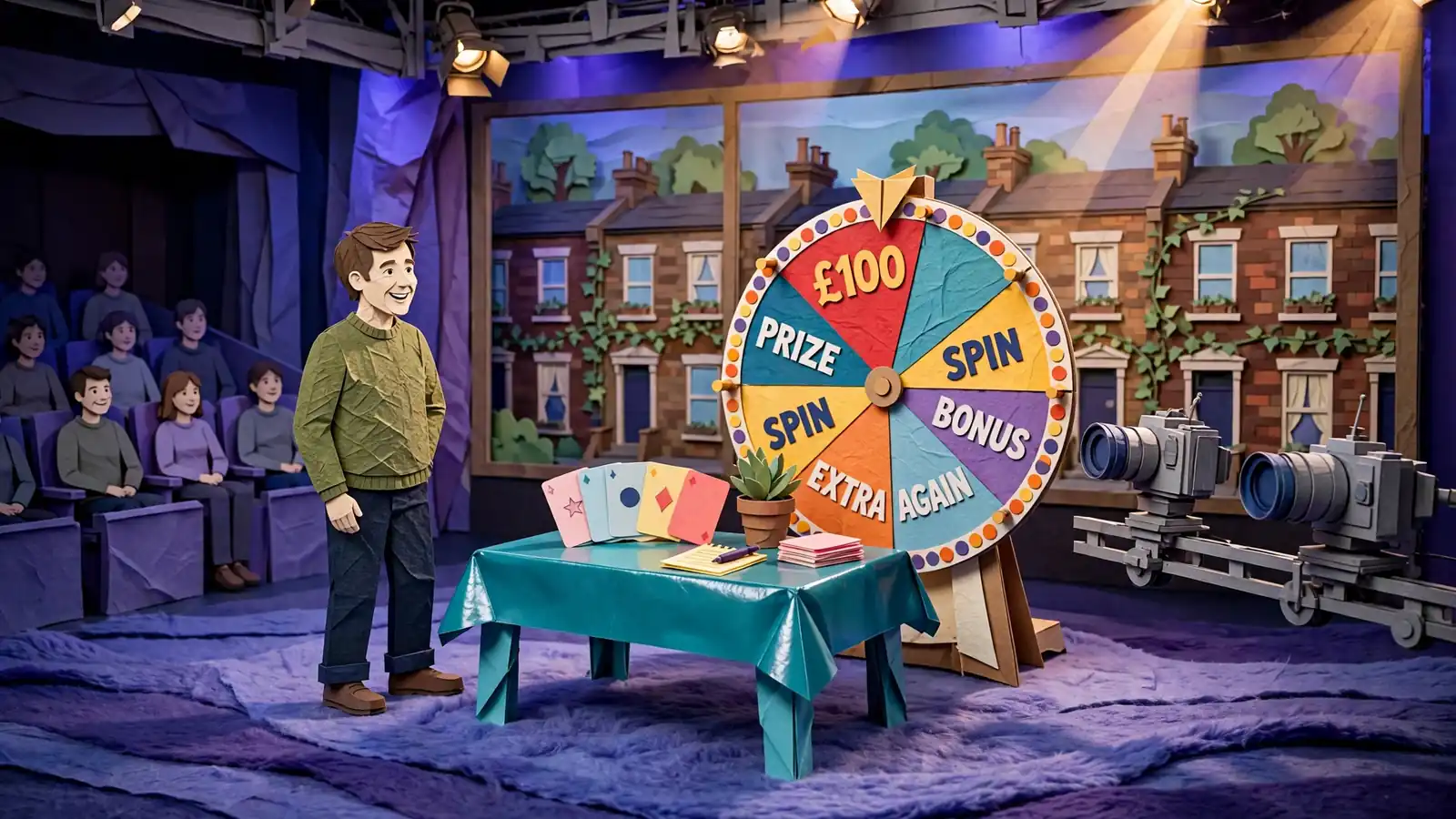
Live casino game shows combine real-time play with television-style presentation, making results feel announced and anticipated rather than simply displayed.
How Casino Game Shows Turn Live Play into Spectacle
A casino game show begins with a change of emphasis. The gambling event is no longer presented as a private act performed behind a screen, with the player and the software left alone together. It is framed as a programme: something staged, timed and watched as it happens. The result belongs to live casino entertainment, but it borrows the grammar of television and the atmosphere of a studio.
That distinction matters. A conventional online casino game may be designed around the quiet repetition of a personal choice. A live game show makes the moment public within its own small digital theatre. The screen is not merely a surface on which a result appears. It becomes a setting in which the result is announced, anticipated and given a little ceremony.
This is the appeal behind the growing interest in live casino game shows online. The phrase can sound like a loose combination of familiar words, yet it describes a recognisable format. A game is conducted in real time, while its presentation gives the event a show-like identity. The attraction is therefore not only the possible outcome. It is the feeling that the outcome has arrived as part of an occasion.
From game to programme
The word live does more work here than indicating an internet connection. It suggests simultaneity. The event is unfolding rather than being retrieved from a library of completed digital rounds. That changes the relationship between the player and the screen. There is a sense of a shared present, even when the people involved are physically separated and the room itself exists somewhere else.
The word show adds a second layer. It implies presentation, pacing and a visible frame around the game. A live game show casino product is not simply a random result with decorative graphics attached. Its identity depends on the event being staged as entertainment. The action has an entrance, a pause, a reveal and an ending, even when these elements are understated.
This is why online casino game shows occupy an unusual place between gambling and broadcasting. They are not television programmes in the ordinary sense: their purpose is connected to casino play. Nor are they merely games with a camera pointed at them. Their form asks the event to carry two kinds of attention at once. One follows the possible result; the other follows the presentation of that result.
Online Casinos With No Limits in the UK: Explained
The arrangement can make a small digital action feel larger than it is. A private click becomes part of an organised sequence. Waiting becomes a visible part of the experience rather than an empty interval hidden by software. Anticipation is given room to exist. In commercial entertainment, that is no minor detail. Suspense needs a stage, and the stage need not be grand to do its work.
The theatre of real time
The strongest feature of casino game shows is their treatment of time. A standard digital game can appear almost indifferent to the clock. It begins when selected and ends when the system produces its answer. Live presentation introduces a different rhythm: the event has a before, a during and an after.
That rhythm produces a kind of social texture. The player is not necessarily speaking with anyone, and no claim of personal intimacy is required. Still, the format can create the impression of being present at the same event as other participants. The feeling is closer to joining a broadcast than opening a solitary piece of software.
This shared timing is especially important because remote gambling otherwise tends towards frictionless privacy. Everything can be compressed: choosing, staking and receiving an outcome. The game show resists that compression. It gives the moment a public shape. Even a short pause can become part of the spectacle, because the pause is no longer merely technical. It is presented as waiting.
There is a cultural history behind this instinct. Games have long been made more compelling by placing them before an audience. Competition, chance and performance have repeatedly been brought together in fairs, halls, clubs and studios. The online casino game show inherits that arrangement without needing to reproduce any particular venue. Its stage is digital, but its logic is old: uncertainty becomes entertainment when it is given a host, a setting and a moment of collective attention.
A machine can produce a result. A show gives the result a place in time.
Why presentation changes perception
Presentation does not alter the underlying fact that chance remains chance. It does, however, change what surrounds the chance. A bare outcome may be understood as a transaction. The same outcome, placed within a live format, can be experienced as an episode.
Format
Live casino game show
Key Feature
Real-time theatrical presentation
Regulatory Body
UK Gambling Commission
That difference explains the continuing interest in the best online casino game shows in the UK. “Best” in this context cannot sensibly mean one universal choice for every player. Live entertainment is judged through atmosphere as much as through technical description. One person may value a measured pace; another may prefer a more theatrical presentation. Someone else may care mainly about how clearly the game is explained or how naturally the format fits a mobile screen. These are questions of design and temperament rather than a single objective ranking.
The important point is that a game show is assessed as a whole. The game itself is one component. Its timing, visual language and sense of occasion are equally relevant to the experience. A format can be mathematically simple and still feel elaborate when the presentation gives it character. Conversely, a visually busy production may feel empty if the spectacle has no relationship to the action.
This is where the phrase live casino game shows differs from a general reference to live casino play. Live casino is a broad category. It may describe games conducted in real time with a visible human or physical setting, without necessarily making the result into a show. Game shows narrow the idea. They place greater weight on entertainment structure and on the transformation of play into a programme-like event.
The boundary is not always sharp. Formats overlap, and commercial labels are fond of stretching across them. Still, the distinction is useful. It prevents every live table or streamed game from being treated as a game show simply because it is broadcast. A camera alone does not create a spectacle. The event must be organised for viewing as well as participation.
The host, the frame and the audience
The human presence associated with a live format serves a practical purpose as well as an expressive one. It gives the event a point of orientation. A studio, a host or an onscreen sequence can tell the audience when one phase has ended and another is beginning. Without that frame, live action can feel like an ordinary digital process with a decorative layer.
EGT online casinos in the UK: how to assess listings
This does not mean that personality is the entire attraction. The format is not dependent on a particular presenter, and it should not be reduced to performance alone. The presenter, where present, belongs to a larger arrangement that includes the rules, the timing, the visual setting and the audience’s expectation of a reveal.
The audience itself is also part of the design, even when its members remain unseen. A show is made with spectators in mind. It explains itself, marks its transitions and makes room for anticipation. The player is positioned not only as someone making a decision but also as someone watching an event unfold.
That double position is one reason online casino live game shows can feel more sociable than ordinary digital play without becoming a social network. The experience does not require conversation to create a sense of company. Simultaneous attention is enough. Several people may be watching the same unfolding event, each from a separate room, with no knowledge of one another. It is a thin form of togetherness, but broadcasting has always depended on such thinness.
There is something revealing in this. Digital entertainment often promises personalisation, yet the enduring pleasure of live formats lies in their refusal to make every moment private. The event is shared, even if the participation is individual.
Spectacle without confusion
Theatrical presentation can clarify a game, but it can also distract from it. A successful casino game show keeps the spectacle connected to the rules and the result. Its visual and dramatic elements should make the sequence easier to follow rather than burying it under noise.
This matters in a remote setting because the screen must carry the entire experience. In a physical venue, atmosphere can be supplied by the room, the people in it and the movement around the table. Online, those surrounding details have to be selected and arranged. The format therefore becomes an exercise in attention: what is shown, what is delayed and what is made prominent.
Online casino game shows occupy an unusual place between gambling and broadcasting, combining real-time play with a staged entertainment structure.
Clarity is not the enemy of excitement. In fact, suspense depends on understanding what is at stake within the game. When the structure is obscure, anticipation becomes mere confusion. When the structure is legible, the waiting period can acquire meaning.
The best online casino live game shows, then, are not necessarily the loudest or most elaborate. Their strength lies in joining three elements without allowing one to swallow the others: the gambling event, the live timing and the entertainment frame. Remove the first and the result is a programme without a casino game. Remove the second and the format becomes prerecorded or purely digital. Remove the third and it becomes live play without the distinctive character of a show.
A British regulatory frame
In Great Britain, this entertainment exists within a defined regulatory structure. The Gambling Commission is the country’s sole regulator for commercial gambling, and its remit covers remote gambling offered to consumers in Great Britain even when the equipment running the service is located elsewhere. Online casinos therefore do not sit outside regulation merely because the screen is remote or the studio is in another place.
The Commission grants operating licences to gambling businesses and personal licences to individuals working in regulated roles. That distinction reflects the two sides of the industry: the organisation that offers the gambling service and the people whose work supports its operation. For live casino game shows, the spectacle may look like broadcasting, but the gambling activity remains part of the regulated commercial system.
This frame is significant because the format can otherwise appear deceptively weightless. A studio image arrives through a browser; the setting may be distant; the action may resemble entertainment programming. Yet presentation does not change the legal character of the activity. A show remains connected to remote gambling when it gives consumers the opportunity to participate in a casino game through an online service.
Best IGT Online Casinos UK: IGT and Amatic Explained
The British approach places responsibility on the regulated gambling structure rather than on the apparent location of the camera or server. That is a sober counterpoint to the theatrical surface. Behind the lights and pacing sits an arrangement of licences, duties and accountability. Spectacle does not dissolve jurisdiction.
The appeal of a visible moment
The enduring attraction of casino game shows is not difficult to understand. Chance is abstract when reduced to a line of code, but it becomes emotionally legible when expressed through a visible event. The audience watches something happen rather than merely receiving information that it has happened.
That difference is central to the format’s place in live casino entertainment. It explains why online casino game shows continue to be treated as a category of their own, why a search for the best live casino game shows is really a search for a particular kind of experience, and why the word “show” matters as much as “casino”.
The format turns an uncertain result into a small public drama. It does not make the outcome less random. It makes the waiting more noticeable, the reveal more ceremonial and the act of participation more closely tied to viewing. In a culture accustomed to instant digital responses, the deliberate return of suspense has its own novelty.
The screen becomes a stage, but not an innocent one. It stages chance, gives it a rhythm and invites attention to remain until the final moment. That is the central craft of the online casino game show: not simply showing a game live, but making liveness itself part of the entertainment.
Best casino sites in the UK
- BeOnBetBonus: 100% up to €500 + 100 FS · Payout speed: 1-3 business days
- NightLuckBonus: Welcome Pack + 805% Up To 6400€ + 280 FS · Payout speed: 1-3 business days
- AmunbetBonus: Join now and get 450% up to 2,700 GBP + 450 FS · Payout speed: 1-3 business days
- JetsetspinsBonus: 200% Bonus + 100 Free Spins + Free Royal Wheel · Payout speed: 1-3 business days
- x3betBonus: Welcome Pack 100% Up to £1.000 + 200 Free Spins · Payout speed: 1-3 business days
- SpinFormulaBonus: 550% Up To £15,000 + 550 FS · Payout speed: 1-3 business days
- EvoSpinBonus: 125% up to €2500 + 125 Free Spins · Payout speed: 1-3 business days
- ChanzeBonus: Slots Welcome Bonus #1 200% up to €500 · Payout speed: 1-3 business days
- SlotoSportBonus: 500% up to £ 10 200+ 777 FS · Payout speed: 1-3 business days
- Revery PlayBonus: 100% up to€1,000+ 100 FS · Payout speed: 1-3 business days
Casinos and the Live Game-Show Experience
A live game show does not arrive online as an isolated television programme. It appears inside a casino: among account controls, payment menus, promotional pages, responsible-gambling tools and the rest of the operator’s remote gambling catalogue. The casino is therefore more than a place where a title happens to be listed. It supplies the conditions in which the show can be watched, entered and settled.
Production Layer
Where the live programme is presented.
Casino Layer
Where the operator lists the offering and connects it to an account.
Regulatory Layer
Where British rules govern the operator’s conduct towards customers.
That distinction matters. A studio may produce the broadcast, while a casino presents the commercial relationship with the player. The studio’s lights and cameras create the visible event; the operator provides the account through which participation takes place. One is entertainment production, the other is regulated remote gambling. Online, they sit in the same window, which can make the boundary look less important than it is.
The casino as the front door
The usual journey begins with the casino’s own interface rather than with a separate destination for every live show. A lobby may divide its catalogue into sections for live content, casino games or other forms of play. The exact labels belong to the operator. So does the decision about which titles are displayed, how they are ordered and whether a particular show is available to a particular account.
This is why the phrase “online casinos with live game shows” describes a relationship rather than a single product category. A casino may host access to a live show while another operator does not. A title may be visible in one market and absent in another. A supplier may produce the programme, but the casino decides whether to integrate that supplier’s content into its own lobby.
Wazdan Online Casinos UK: What the Record Shows
The presence of a title in a lobby is not the same as a separate licence entry for that title. In Great Britain, the operator serving the customer is the relevant commercial party. The UK Gambling Commission issues operating licences to businesses and personal licences to people working in the sector; it also regulates remote gambling offered to consumers in Great Britain, even when the equipment supporting it sits elsewhere. The screen may look international. The responsibility is not so vague.
A casino’s UKGC licence is therefore part of the experience, even when it remains in the background. It governs the operator’s relationship with the customer: deposits, withdrawals, account checks, bonus terms, complaints procedures and the handling of gambling-related risks. The live-show label may be glamorous. The account architecture is where the serious work takes place.
What an operator adds to the show
A live game-show offering needs more than a video feed. The casino connects the visible broadcast with an account, a balance and the settlement of bets. It also places the show beside the ordinary machinery of remote gambling: identity checks, payment restrictions, session information and tools for controlling expenditure.
Before a first deposit, a UKGC-licensed operator must ask the customer to set a financial limit. If that limit is reduced, the change has to be applied immediately. This requirement belongs to the casino environment, not to the studio set. The presenter may keep the pace moving, but the operator remains responsible for the less theatrical question of how money enters the account and how the account is governed.
Do
- Check for a valid UKGC licence
- Set financial limits before your first deposit
- Verify your age through the operator
Don’t
- Use credit cards to fund your account
- Assume an offshore site provides UK protections
- Treat a supplier’s name as a casino licence
Age verification is another part of that structure. Customers must be checked as adults before they can deposit funds, and legal remote gambling in the UK is for people aged 18 and over when the operator holds the appropriate UKGC licence. The show itself cannot establish legality merely by appearing on a polished website. The account controls do that work.
Payment arrangements also belong to the operator. Credit cards cannot be used to fund remote gambling, including through an e-wallet funded by a credit card. The casino is consequently not just a shop window for live entertainment. It is the regulated gate through which the money side of that entertainment must pass.
A useful way to understand the arrangement is to separate three layers:
- The production layer, where the live programme is presented.
- The casino layer, where the operator lists the offering and connects it to an account.
- The regulatory layer, where British rules govern the operator’s conduct towards customers.
These layers may be invisible while everything runs smoothly. They become conspicuous when a title disappears, a payment is delayed or a complaint needs to be handled. Then the casino’s role stops looking like a decorative frame.
Why availability changes between casinos
There is no single universal catalogue of live game shows shared by every UK casino. Operators make separate commercial and technical decisions about the content they carry. They may integrate different suppliers, arrange different lobby categories or change what is shown to customers over time.
That makes a general list of “best live game-show casinos” rather less stable than the phrase suggests. A casino can be prominent in one description and absent from another without either statement remaining accurate for long. The relevant question is not simply whether a site uses the word “live”, but whether the desired offering is currently displayed in its own lobby and available under its current terms.
The same caution applies to promotional claims. A casino may place live content near a welcome offer or another incentive, but the wording of that promotion is controlled by the operator. British rules cap bonus wagering requirements at 10× the bonus funds. Promotional terms must therefore be read as part of the casino’s current offer, not treated as a permanent feature of the live show itself.
Mixed-product promotions are also not an acceptable shortcut. A casino bonus cannot be presented as a package with sportsbook free bets where the market rules prohibit that arrangement. The fact that the live show sits within a broad gambling brand does not erase the boundaries between products. A large lobby is still made of separate regulatory compartments.
Some operators advertise free-spin rewards with 0× wagering, so any resulting payout is credited as cash without a playthrough requirement. Such an offer remains an operator’s promotion, not a universal property of casino entertainment. The conditions can include eligibility requirements and a defined distribution period; a claim about one operator’s terms should not be stretched into a description of the whole market.
Betsoft Online Casinos UK: Licensing and Games
The difference between a casino and a supplier
The casino’s visible brand can obscure the businesses behind the content. A supplier may create games or provide the technical feed, while the operator presents the material under its own licence. In another arrangement, a casino may use an aggregator that brings together content from several providers. To the customer, both routes can look like one lobby.
This separation is familiar in other areas of online gambling. Amatic Industries, for instance, is a B2B software supplier rather than a consumer-facing casino. Its UK Gambling Software licence allows it to supply games to British operators; it does not authorise the company to accept player deposits or pay winnings directly. Those duties remain with the operator that holds the relevant operating licence.
The example is useful even though Amatic’s catalogue does not include live-dealer games. It shows why a provider’s presence should not be mistaken for a casino licence. A supplier can be named beside a title without being the business that handles the customer’s money. A studio can produce a live programme without being the company that carries the customer’s account.
For British players, the operator is the practical point of accountability. It is the party responsible for the terms displayed on the site, the treatment of deposits and withdrawals, customer support and the measures required under the LCCP. The supplier’s name may explain where the content came from. It does not replace the casino’s obligations.
A casino lobby is an editorial decision
The ordering of a casino lobby says something about the operator’s priorities. A live section may be placed at the front because the business wants the atmosphere of a broadcast to lead the visit. Another site may bury the same type of content beneath conventional casino categories. Neither arrangement changes the underlying nature of the offering, but both shape how the experience feels.
The Core Identity
A game show combines the uncertainty of a casino game with the structured rhythm of a television programme.
This is the quiet power of the casino as venue. It selects the doorway, sets the labels and decides which parts of the catalogue receive attention. The show may be designed to feel immediate and communal; the lobby determines how easily that feeling is reached and what appears beside it.
A listing should not be confused with independent approval. When a casino displays a provider or title, that is an editorial and commercial choice by the operator. It is not evidence that the provider has been separately endorsed as a consumer-facing casino. Nor does the listing by itself establish that the same content is available at every other UKGC-licensed operator.
Availability can also depend on location within the British market and on the operator’s current integration. A website may carry a general live-casino label while changing the underlying catalogue. This is one reason static recommendations can age quickly. A page written as though a casino’s lobby were a permanent public register is describing an imaginary object.
Not very glamorous, but important.
What a properly licensed casino contributes
The regulated casino contributes protections that belong to the account rather than the broadcast. GamStop has been mandatory for all Great Britain-licensed online operators since 31 March 2020. A customer using a licensed operator therefore encounters the self-exclusion scheme as part of the wider casino environment, not as an optional ornament attached to a particular show.
Financial-limit prompts, age checks and restrictions on credit-funded gambling work in the same way. They apply because the operator is offering remote gambling to British customers, not because a presenter happens to be visible on screen. The live format may attract attention, but the regulatory duties follow the transaction.
The rules for online slots illustrate the same point from another angle. The maximum stake per game cycle is £5 for customers aged 25 and over and £2 for those aged 18 to 24. Those limits concern online slots, not every form of live casino content. A casino’s broad menu can place several products together, but a rule attached to one product should not be casually transferred to another.
Amatic Games at UK Online Casinos: How They Work
Nor should the presence of a UKGC licence be treated as a guarantee that every item in a large catalogue has identical terms. The operator remains responsible for explaining the conditions attached to each offering. The casino is a venue with sections, not one undifferentiated game.
Offshore sites and the missing protections
Some offshore casinos may display casino content while operating outside the UK regulatory framework. Curaçao-licensed Winstler and Anjouan-licensed MrJones are examples of offshore operators offering Amatic games, but they do not hold a UKGC licence. Their existence does not place them inside the British system.
That distinction is especially important when the attraction is a live-show atmosphere. A polished interface, a streaming studio and a familiar vocabulary can make a site appear closer to a British operator than it legally is. Appearance is a poor substitute for jurisdiction. Remote gambling operators selling into the British market must hold the relevant Gambling Commission licence, regardless of where their key equipment is located.
A customer is not criminally liable merely for playing at an offshore casino without a UK licence. The absence of player liability, however, does not turn an offshore operator into a UK-regulated one. Nor does it provide the protections associated with the British system, including GamStop access and UKGC complaints routes. Advertising of offshore or unlicensed operators is restricted in the UK; the distinction is not a technical footnote for websites to hide beneath a brightly lit game-show banner.
The sensible unit of comparison is therefore not “which casino looks most like television?” It is “which operator is legally responsible for the remote gambling relationship, and what does its current offer actually contain?” The first question concerns the framework. The second concerns the changing lobby.
Is a live game show the same as a live dealer game?
No. While live casino play involves real-time action, a game show specifically focuses on entertainment structure and turning play into a programme-like event.
Does the host influence the game outcome?
No. The presenter provides continuity and atmosphere, but the outcome remains governed by chance and mathematics.
Can I use a credit card for these games in the UK?
No. Payment arrangements in the UK prohibit the use of credit cards to fund remote gambling.
Reading the experience as a whole
A casino with live game shows is best understood as a layered venue. The show supplies the public face; the operator supplies the account, the payment system and the terms; the UK regulatory system sets the boundaries within which that relationship can operate.
That arrangement explains why the same live programme can feel different from one casino to another. The broadcast may be similar, yet the route into it, the surrounding promotions, the account tools and the available protections belong to the operator. A casino is not a neutral window cut into a universal entertainment channel. It edits the view.
For that reason, the strongest description of a UK live-show casino cannot rest on atmosphere alone. It must account for the operator behind the lobby, the licence governing the account, the current availability of the content and the rules attached to the particular product. The lights may be shared. The responsibilities are not.
The High-Energy, Chance-Driven Show Format
Some live casino formats are built less like traditional table games than like television variety shows. Their purpose is not quiet concentration around a virtual layout. It is movement, colour, suspense and the sense that something may happen before the audience has settled into its seat. The chance mechanism remains simple; the presentation makes it feel eventful.
This is the territory behind searches for lively formats such as the Crazy Time or Funky Time style of live casino game show. The names suggest an atmosphere before they explain a rule. That is deliberate. A conventional roulette table announces its seriousness through stillness: the wheel, the ball, the measured voice. A high-energy show does the opposite. It turns anticipation into part of the product.
Chance with a stage around it
At the centre is a random outcome. A wheel, draw, multiplier feature or other chance-led device determines what happens next. Around that mechanism sits the show: a presenter, a studio set, music, graphics and a sequence of visual cues. The result is still governed by chance, but chance has been given a costume and a running order.
Amatic Games at UK Online Casinos: What to Know
That distinction matters. The spectacle does not make an outcome more predictable, and the presenter does not acquire any influence over it by announcing it dramatically. The theatre belongs to the experience, not to the mathematics. A bright set may make a pause feel longer; it cannot make a particular segment appear.
The format borrows from broadcasting because broadcasting has always understood the value of delay. A result revealed instantly is information. A result approached through a countdown, a gesture or a change in music becomes an episode, however brief. Live game shows use that small interval to turn a mechanical event into communal attention.
Why “high energy” is not a rule
The phrase describes presentation rather than a single game design. One show may rely on a large wheel, another on bonus rounds, another on sudden changes in pace or animated prompts. What they share is a preference for visible action and emotional contrast: anticipation followed by release, ordinary outcomes beside more elaborate features, calm explanation interrupted by bursts of ceremony.
That variety is why the style should not be reduced to a catalogue of titles. The same broad mood can be created through different devices. The useful question is not whether every show contains identical features, but whether the format makes chance feel like a public performance rather than a private calculation.
The presenter is important here, although not as a strategist. Their role is to maintain continuity, explain the sequence and give the audience a human point of focus. In a standard digital game, interface elements perform those tasks through buttons and labels. In a live show, a person does it aloud, with all the small variations of timing and expression that a designed interface does not possess.
High-Energy Formats
Certain live casino formats are built like television variety shows, using movement, colour, and suspense to create an eventful atmosphere.
A little theatre goes a long way.
The appeal of the unpredictable
Chance-driven shows offer a particular kind of suspense because the next event is both legible and unknowable. The audience can understand the basic action without mastering a complicated system, yet the outcome remains outside anyone’s control. That combination lowers the barrier to entry while preserving uncertainty.
It also creates a rhythm different from that of a conventional slot. A slot repeats a compact cycle through symbols and sound. The show format stretches the cycle into an occasion. There may be an announcement, a visible transition, an outcome and a reaction. The waiting becomes part of the entertainment, not merely the space between decisions.
This helps explain the attraction of “crazy” or “funky” branding. Such language promises departure from the restrained vocabulary of the casino floor. It signals that the format will be playful, exaggerated or knowingly theatrical. The adjective is not a guarantee of a particular result. It is a declaration of tone.
For the same reason, the style can appeal to people who are interested in live entertainment as much as in gambling mechanics. The studio is presented as a social space, even when the participants are physically elsewhere. On-screen presenters, shared rounds and a common visual event create the impression of an audience gathered around one moment. The social quality is mediated, but it is not imaginary: television has been doing something similar for generations.
Spectacle and restraint
The liveliness of the format should not obscure its central fact. It remains chance-led remote gambling, and the showmanship does not alter the conditions attached to the underlying game. A cheerful presenter cannot turn uncertainty into skill, while a dramatic bonus sequence cannot make a random result reliable.
Barcrest Online Casinos UK: Licensing and Availability
In Great Britain, the surrounding regulatory culture is notably less theatrical. Remote operators must work within the UKGC framework, and responsible-gambling controls sit behind the bright graphics: age verification, financial-limit prompts and access to GamStop form part of the environment in which such entertainment is offered. The contrast is revealing. The front of the product performs spontaneity; the system supporting it is built around recorded checks and fixed obligations.
That tension is part of the modern game show. It sells excitement without being allowed to pretend that excitement is evidence. The spectacle may be loud, but the underlying proposition is plain: a live presentation of chance, shaped for attention and delivered with the manners of television.
What Makes a Live Casino Game Show
A live casino game show sits between two familiar forms of entertainment. It has the uncertainty of a casino game, but it is arranged like a television programme: a host, a visible sequence of events, a defined rhythm and an audience that watches outcomes unfold together. The point is not simply that a gambling game is broadcast. The broadcast becomes part of the game’s identity.
That distinction matters. A conventional online casino game can be played almost silently, with the software presenting symbols, cards or numbers on demand. A live game-show casino experience adds a human-led performance around the result. The host explains what is happening, keeps the pace moving and gives the event a social surface. The player is no longer looking only at an interface. There is a studio-like setting, a presenter and the feeling of an occasion, even when the activity takes place through a browser.
More than a game with a camera
A camera alone does not create a game show. A live feed of a dealer performing a conventional casino procedure may be live, but the game-show character comes from the presentation surrounding it. The format has recognisable stages: an opening, an invitation to participate, a moment of suspense and a result that closes the round.
Summary
- Live game shows turn a private act into a shared digital spectacle.
- The operator provides the regulated framework, including account controls and safety tools.
- Effective shows balance the gambling event, live timing, and entertainment frame.
- UK regulation applies to the remote gambling activity regardless of the studio’s location.
This structure borrows from television’s oldest habit: turning waiting into entertainment. A result that might otherwise appear instantly is given a beginning and an interval. The host’s commentary, the visual setting and the order of the round make chance feel like an event rather than a calculation. The outcome remains uncertain, but the uncertainty is packaged for an audience.
That packaging is the defining idea. The show does not remove the gambling element; it gives it a public shape.
The host as part of the mechanism
In a live casino game show, the presenter is not merely decoration placed beside a digital product. The host provides continuity between rounds and translates the rules into a shared performance. Their role may include announcing stages, acknowledging the audience, maintaining momentum and marking the transition from anticipation to result.
This creates a different relationship with time. A software game generally waits for an individual action and responds to it. A show establishes a communal tempo. Participants may be making separate decisions from separate places, yet the visible round gives them a common point of attention. The arrangement resembles a broadcast more than a solitary pastime.
The distinction also explains why presentation quality matters. Sound, camera work, graphics and the clarity of the host’s explanations are not ornamental extras. They determine whether the format feels like a coherent show or merely a random result surrounded by studio effects. When the performance is intelligible, the entertainment has a shape. When it is not, the machinery shows through.
Participation without physical presence
The word “live” can be misleading if it is taken to mean physical attendance. In this context, it describes the delivery of the event and the shared timing of the round, not a room in which players sit together. The casino game show remains remote gambling: participation occurs through an operator’s digital service, while the performance is transmitted to the screen.
This gives the format an unusual social quality. It is more communal than an entirely automated game, yet less intimate than being present in a studio. The participants do not need to speak to one another, and the host cannot turn the event into a private conversation with every person watching. The connection is staged and one-directional, but it is still a connection. Television understood this long before online casinos borrowed its grammar.
Chance framed as entertainment
The show format also changes how chance is perceived. Randomness is usually a cold concept: an outcome appears, and the explanation ends there. A presenter can give that interval a mood. The pause before a result, the announcement of a winning outcome and the visual confirmation that follows all make uncertainty easier to experience as drama.
That drama should not be confused with influence. A lively presentation does not make an outcome more predictable, and a host does not turn chance into skill. The performance may make the round memorable, but it does not change its underlying nature. This is where the format’s charm and its risk meet: entertainment can make the passage of time feel lighter, while also making repeated participation feel more absorbing.
A bright set cannot alter probability.
How the casino element remains visible
For the format to remain a casino game show rather than a general television programme, participation must still be connected to a gambling activity. The show supplies the setting and the rhythm; the casino framework supplies the wager and the result. Neither side is sufficient on its own.
The distinction is useful in the British market, where remote gambling is offered through UKGC-licensed operators and subject to the protections attached to that arrangement. A live presentation does not place an activity outside those responsibilities. The fact that a game resembles a television programme does not make it television in the legal or practical sense. It remains a gambling product delivered through a regulated remote service.
A well-defined live casino game show therefore has four elements working together: a live or live-presented broadcast, a host-led structure, a clearly staged sequence and a chance-based casino outcome. Remove the broadcast and the event becomes an automated game. Remove the casino element and it becomes a game show in the ordinary television sense. Remove the structure and there is little left but a camera pointed at a result.
Its identity lies in the combination. The casino supplies uncertainty; the show supplies ceremony. The screen turns a private act of remote gambling into a small public performance, complete with an opening, a pause and an ending.
Are Amatic games licensed and legal to play in the UK?
Yes. Amatic Industries holds a UK Gambling Software (Remote) licence, and its games are available through UKGC-licensed casinos.
What is Amatic Industries and when was it founded?
Amatic Industries GmbH is an Austrian business-to-business gaming software supplier founded in 1993. It launched its online gaming division, AMANET, around 2010.
What is the maximum I can stake on Amatic slots in the UK?
The UK online slot limit is £5 per game cycle for players aged 25 and over, and £2 for those aged 18 to 24.
Do Amatic casinos work on mobile phones and tablets?
Yes. Amatic games generally run in a mobile browser as HTML5 games, without a download.