

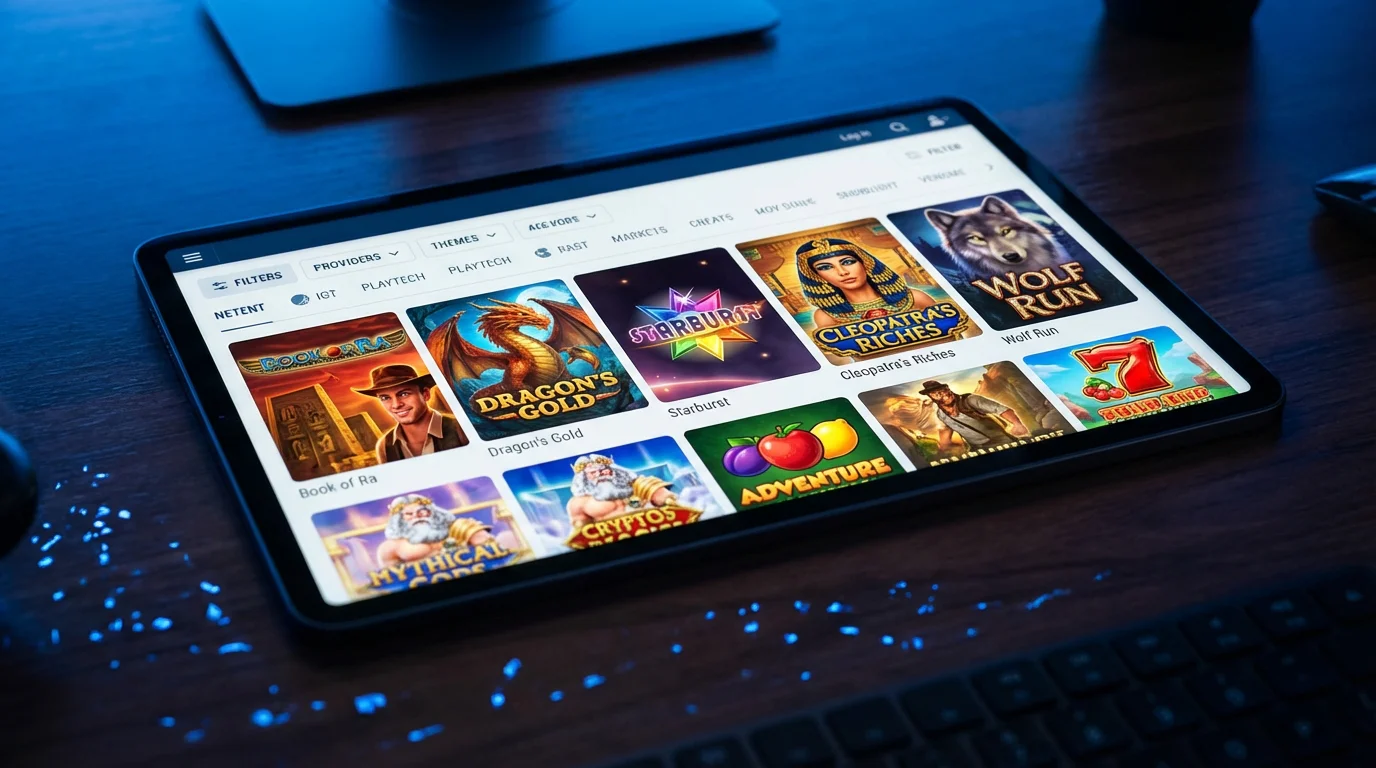
Game Providers: Who Makes What You Play
Behind every game is a studio—knowing them helps. Casino apps don’t create the games they offer; they license content from specialised development studios called game providers. These companies design, develop, and maintain the slots, table games, and live dealer products that appear across multiple casino platforms. Understanding provider identities and characteristics helps you find games matching your preferences regardless of which app you’re using.
Provider selection defines much of a casino app’s character. An app carrying extensive Pragmatic Play content feels different from one focused on NetEnt titles, even if both apps offer thousands of games. The visual styles, gameplay mechanics, bonus structures, and RTP ranges that providers favour create distinct experiences that transcend individual titles.
Recognising providers also helps locate favourite games across different apps. If you enjoy a particular slot at one casino, knowing which provider made it lets you find the same game at other casinos—and discover similar titles from the same studio. Provider loyalty often makes more sense than game loyalty because studios maintain consistent quality standards across their catalogues.
The UK market features games from dozens of providers, ranging from industry giants releasing hundreds of titles annually to boutique studios known for specific game types. Learning to navigate this landscape enhances your ability to find games worth playing and apps worth using.
Major Game Providers on UK Casino Apps
The studios powering your sessions. Several providers dominate UK casino app game libraries through combination of prolific output, consistent quality, and strong operator relationships.
Pragmatic Play has emerged as perhaps the most prolific slot provider in the current market. Their release schedule outpaces most competitors, with new titles appearing weekly. Quality remains consistently solid if not always exceptional, and their games feature prominently in casino promotions and featured game sections. Sweet Bonanza, Gates of Olympus, and the Dog House series represent their most recognisable franchises. Their live casino division has grown rapidly, now rivalling Evolution in some markets.
NetEnt maintains its reputation as a premium slot developer despite being acquired by Evolution Gaming. Classic titles like Starburst, Gonzo’s Quest, and Dead or Alive established the modern video slot template that competitors still follow. Their production values remain high, though release frequency has slowed compared to peak years. NetEnt games often feature in casino welcome offers due to their broad player recognition.
Evolution Gaming dominates live dealer gaming so thoroughly that their presence defines whether a casino can claim serious live casino credentials. Their acquisition of NetEnt in 2020, Red Tiger, and Big Time Gaming in 2021 has extended their influence into slots, but live casino remains their core strength. Immersive Roulette, Lightning series games, and Crazy Time showcase production capabilities that competitors struggle to match.
Play’n GO offers a catalogue deep in quality if not always headline-grabbing. Book of Dead remains their signature title, driving significant traffic across UK casinos. Their slots typically feature clean designs, solid mathematics, and reliable mobile performance. The studio’s consistent output provides backbone content that fills casino libraries without dominating promotional attention.
Microgaming historically pioneered online casino gaming but now primarily operates as a content aggregator, distributing games from partner studios under the Microgaming banner. Their progressive jackpot network, including Mega Moolah, remains their most distinctive offering. Understanding that “Microgaming” games may originate from various studios helps calibrate quality expectations across their diverse catalogue.
Big Time Gaming created the Megaways mechanic that has reshaped slot design industry-wide. Their original Megaways titles and the licensing of the mechanic to other providers established BTG’s influence far beyond their own game count. Bonanza, launched in 2016, and Extra Chilli remain benchmarks for the format they invented.
Red Tiger Gaming produces polished slots with strong mobile optimisation and engaging bonus features. Now part of the Evolution family, they maintain distinct identity through their progressive jackpot network and daily jackpot offerings. Their games consistently perform well on casino featured lists.
Best casino sites in the UK
- BeOnBetBonus: 100% up to €500 + 100 FS · Payout speed: 1-3 business days
- NightLuckBonus: Welcome Pack + 805% Up To 6400€ + 280 FS · Payout speed: 1-3 business days
- AmunbetBonus: Join now and get 450% up to 2,700 GBP + 450 FS · Payout speed: 1-3 business days
- JetsetspinsBonus: 200% Bonus + 100 Free Spins + Free Royal Wheel · Payout speed: 1-3 business days
- x3betBonus: Welcome Pack 100% Up to £1.000 + 200 Free Spins · Payout speed: 1-3 business days
- SpinFormulaBonus: 550% Up To £15,000 + 550 FS · Payout speed: 1-3 business days
- EvoSpinBonus: 125% up to €2500 + 125 Free Spins · Payout speed: 1-3 business days
- ChanzeBonus: Slots Welcome Bonus #1 200% up to €500 · Payout speed: 1-3 business days
- SlotoSportBonus: 500% up to £ 10 200+ 777 FS · Payout speed: 1-3 business days
- Revery PlayBonus: 100% up to€1,000+ 100 FS · Payout speed: 1-3 business days
What Each Provider Does Best
Different studios, different specialities. Understanding provider strengths helps match games to preferences without sampling everything blindly.
High volatility specialists include Hacksaw Gaming, Nolimit City, and Push Gaming. These studios build slots designed for dramatic variance—extended losing periods followed by potentially massive wins. Their games suit players seeking adrenaline-inducing sessions over steady entertainment. Mental Multiplier Max and xNudge mechanics exemplify their approach to extreme win potential.
Consistent, player-friendly RTPs characterise some providers over others. NetEnt historically maintained relatively high return rates across their catalogue. Blueprint Gaming and Thunderkick similarly tend toward reasonable RTPs without dramatic outliers. Players prioritising mathematical efficiency often gravitate toward these studios.
Live casino excellence remains Evolution’s domain despite growing competition. Their investment in studio infrastructure, dealer training, and game innovation maintains quality advantages that alternatives haven’t matched. Pragmatic Play Live has closed the gap significantly, offering credible competition at somewhat lower production values but perfectly adequate quality for most players.
Jackpot networks differentiate certain providers. Microgaming’s Mega Moolah network holds records for largest payouts. Red Tiger’s daily jackpots provide smaller but more frequent prize opportunities. NetEnt’s jackpot games, while less famous, contribute to viable progressive options. Players chasing life-changing wins should identify which networks specific apps carry.
Mobile-first design characterises newer studios who built their games for smartphone play from inception. Older providers sometimes show their desktop origins through interfaces that feel compressed on phone screens. Studios like Yggdrasil and ELK Studios prioritised mobile from their founding, and their games reflect that orientation in control placement and visual design.
Branded content comes primarily from larger studios with licensing budgets. NetEnt’s branded slots—Jumanji, Narcos, Vikings—leverage recognisable intellectual property. Pragmatic Play has moved into branded territory more recently. These games trade RTP for entertainment value, typically carrying lower returns than original titles due to licensing costs.
Finding Specific Providers on Apps
Hunt down your favourites. Locating games from preferred providers requires navigating casino app interfaces that vary in helpfulness. Some apps facilitate provider searching excellently; others make it surprisingly difficult.
Provider filters appear in well-designed casino lobbies. Look for filter icons or dropdown menus that allow limiting displayed games by studio. Selecting your preferred provider instantly reduces thousands of games to the specific catalogue you want to explore. This feature, when present, transforms game discovery from random browsing to targeted searching.
Search functionality sometimes accepts provider names as search terms. Typing “Pragmatic” or “NetEnt” into a casino’s search bar may return all games from that studio. The effectiveness varies by app—some search implementations understand provider queries while others only match game titles. Testing search behaviour at your preferred apps reveals whether this approach works.
Game information screens identify providers for individual titles. Opening a game’s info section—usually accessible through menu icons on the game tile—typically displays the provider name alongside RTP and other specifications. This allows identifying who made games you discover through browsing, even when provider filters aren’t available.
Provider sections exist at some casinos as dedicated lobby areas. Rather than filtering a single game list, these apps create separate pages for each major provider. Navigation to “NetEnt Slots” or “Pragmatic Play Games” provides curated access to specific catalogues. This organisation style particularly suits players with strong provider preferences.
Third-party databases help when app interfaces fail. Websites cataloguing casino games by provider can identify which studios made games you’re searching for, enabling targeted searching even when the casino itself doesn’t highlight provider information. Cross-referencing known provider catalogues against casino game lists reveals whether specific apps carry the providers you want.
Not all casinos carry all providers. Licensing relationships determine content availability, and some providers maintain exclusive arrangements with certain casino networks. If your favourite provider’s games don’t appear at a particular app, they may simply not have a supply agreement. Finding an alternative app with the provider relationship you need becomes the solution.
Provider Exclusive Games
Some games only appear in certain places. While most provider content distributes broadly across casino apps, exclusive arrangements occasionally restrict specific titles to limited platforms.
Network exclusives tie certain games to casino groups. Large operators sometimes commission exclusive titles from providers, available only across their owned brands. These exclusives provide differentiation in competitive markets where standard provider catalogues appear everywhere. Discovering these requires exploring specific casino networks rather than assuming all games appear universally.
Timed exclusives grant early access to new releases. Providers may launch games at selected casino partners weeks before broad distribution. Being a first-launch partner has marketing value for casinos, while providers benefit from focused promotional support. Players following specific providers closely can identify which casinos receive early access to anticipated releases.
Regional exclusives exist where licensing or regulatory differences affect availability. A game available throughout European markets might not appear in UK casinos due to content concerns or licensing decisions. Conversely, some games receive UK-specific versions with modified RTPs or features meeting British regulatory preferences.
Platform exclusives tie some games to specific casino platforms or aggregators. Casinos built on particular white-label platforms may access games unavailable to competitors using different technical infrastructure. These platform-level exclusives are less visible to players but can explain why certain games appear at some apps but not others despite apparent provider availability.
Rising Providers to Watch
The next generation of game makers. Beyond established giants, several newer studios are building reputations through distinctive content and growing casino distribution.
Hacksaw Gaming has rapidly gained recognition for extreme volatility slots with innovative features. Founded in 2018, their games appear increasingly across UK casinos, with titles like Wanted Dead or a Wild demonstrating their capacity for high-engagement content. Their aesthetic style is distinctive and their feature mechanics often feel genuinely fresh.
Nolimit City carved out similar territory with “xMechanics” innovations that push volatility boundaries, including xNudge, xWays, and xBomb features. San Quentin, Mental, and other controversial-themed slots built their reputation among players seeking extreme experiences. Their UK presence continues expanding despite occasionally provocative content choices.
Print Studios, Wizard Games, and other newer entrants bring fresh perspectives without the accumulated catalogues of established players. These studios sometimes take creative risks that larger providers avoid, producing games that feel distinctive rather than derivative. Discovering promising titles from these emerging studios rewards adventurous players.
Consolidation trends affect the landscape as larger entities acquire successful smaller studios. Today’s rising provider may become tomorrow’s subsidiary of Evolution or another industry giant. This doesn’t necessarily change game quality but can affect future development direction and catalogue availability. Following industry news helps track these shifts.
Find top casino apps at realmoneycasinoandroid. Compare them in our top 10 Android casino apps.