

A practical guide to UK licensing, roulette payouts, bonus restrictions and how the single-zero wheel compares with American roulette.
What Makes a Roulette Casino Fit for Britain
A casino offering European roulette is not automatically a suitable choice for someone in Britain. The wheel may look familiar, the name may contain “VIP”, and the lobby may even place roulette beside themed slots, but the first question is more prosaic: whether the operator is permitted to serve the British market at all.
The UK Gambling Commission (UKGC) is the sole regulator of online casino activity in Great Britain. Remote gambling operators selling to customers there must hold the relevant UKGC operating licence, wherever the company itself is based. A casino without a valid licence cannot legally offer real-money gambling to British residents. That makes the licence a condition of entry, not a decorative badge in a website footer.
The licence number should be checked on the UKGC public register before money is deposited. This is more reliable than relying on a logo, a review page or a claim that a platform is “licensed in the UK”. A current listing identifies the regulated operator behind the service and gives a firmer basis for considering its roulette offering. It also separates genuine British-facing casinos from offshore sites that sit outside the UKGC system.
Checks before a first deposit
Age verification is another basic test. Operators must verify a customer’s age before allowing funds to be deposited into a gambling account. A registration form that appears to let a new customer move straight from sign-up to payment without this check is not behaving as a British-facing casino should.
A properly operated account should also make important information visible before play begins. RTP information for the roulette game should be accessible rather than hidden behind vague claims about fairness. RTP is not a promise about an individual session, nor does it turn a chance game into a predictable one. It is useful because it allows the mathematical character of a game to be inspected instead of accepted on trust.
Online Casino Tournaments UK: Formats and Limits
The same practical standard applies to account controls. Remote operators must prompt new customers to set a financial limit before the first deposit and provide accessible controls for limits at account level. A casino that makes it easy to increase activity but difficult to set or change protective boundaries has arranged its priorities rather clearly.
Safer-gambling tools should be visible in the account area, not buried in an obscure help page. UKGC-licensed casinos must provide responsible-gambling measures, including self-exclusion. For licensed live casino operators, the required safeguards include deposit limits, loss limits, session-time reminders, reality checks, cool-off periods and GamStop self-exclusion. These are not ornamental features for a responsible-gambling page; they are part of the framework under which British operators work.
GamStop matters because self-exclusion is intended to interrupt access across participating licensed gambling services, rather than relying on a single casino’s memory. A casino that presents safer play as a marketing flourish while concealing the actual controls offers little evidence of a serious compliance culture.
Payments and complaints
Payment methods reveal another boundary. Remote gambling operators cannot accept credit-card payments for gambling, including credit-card funding routed through a money service business. They also cannot accept wallet payments when that wallet allows credit-card funds to be used for gambling. A payment page should therefore be judged by how it handles the source of funds, not simply by how many logos it displays.
A UKGC-licensed casino must provide an internal complaints process and access to an approved Alternative Dispute Resolution service. Those routes matter when an account, payment or game-related issue cannot be settled through ordinary customer support. The operator must also contribute to the Research, Education and Treatment levy, part of the wider regulatory structure surrounding gambling in Britain.
This does not produce a fixed ranking of the best European roulette casinos UK players can use. Operators change their games, terms and licences, while a polished front end can outlive the conditions that once made it trustworthy. The sensible assessment is therefore procedural: confirm the UKGC licence, check the age and payment controls, locate RTP information, inspect account limits and make sure self-exclusion and complaints routes are genuinely available.
A roulette table comes later. The paperwork comes first.
Format
European roulette (single zero)
House Edge
2.70%
Regulatory Requirement
UKGC Operating Licence
Key Pockets
37 (1-36 and a single green zero)
The European Wheel: Thirty-Seven Pockets and One Zero
The European roulette wheel is built around a simple imbalance disguised as symmetry. Its pockets are numbered from 1 to 36, with one green zero completing the circle. That makes 37 pockets in all: thirty-six numbered spaces and a single space that belongs to neither red nor black, odd nor even, high nor low.
The arrangement gives the game its identity. The numbers are not placed in ascending order around the rim. Instead, they follow a fixed sequence designed to distribute high and low numbers, colours and odd and even numbers around the wheel. The result is visually restless: a run of numbers on the rim does not resemble the orderly grid printed on the betting surface. The wheel is a circular object with its own geography, not merely a rotating version of the table.
When the game begins, a ball travels around the outer track while the wheel turns beneath it in the opposite direction. The ball loses speed, meets deflectors and eventually falls towards the central pockets. Small separators divide the spaces, encouraging the ball to settle into one pocket rather than roll across several. The final result is the pocket in which the ball comes to rest.
That process matters because roulette has no memory. A red result does not make black more likely; a long absence of a number does not make that number “due”. The wheel does not keep a moral account of previous spins. Each new spin is another chance for the ball to enter any one of the 37 pockets.
French Roulette Online Casinos in the UK
This is where the zero becomes more important than its size suggests. On the wheel, it occupies only one pocket. On the betting system, however, it prevents many apparently balanced choices from being perfectly balanced. Red and black are not equal to the whole wheel because zero is neither. The same applies to even and odd, and to the customary divisions between lower and higher numbers. The green pocket sits outside those paired categories, quietly preserving the casino’s advantage.
European roulette therefore has a house edge of 2.70%. In practical terms, that figure describes the mathematical advantage created by the extra zero over the otherwise balanced numbered field. It is not a forecast of what must happen in a short session, nor a deduction from any particular sequence of spins. A player can see a cluster of results that looks wildly different from the long-run calculation. The edge is a property of the game as a whole, emerging over repeated play rather than announcing itself on every turn.
The wheel’s design also explains why the word “European” is more than a decorative label on an online casino game. It identifies the single-zero format. American roulette uses 38 pockets because it adds a second green space, the double zero, to the numbered wheel. That extra pocket changes the mathematics and makes the two versions different games, even when their colours, numbers and familiar betting language appear similar. Some online tables also display a third green pocket marked 000; a specialist review has described such a version as carrying a house edge of 7.69%, but that is a changing product detail rather than a defining feature of European roulette.
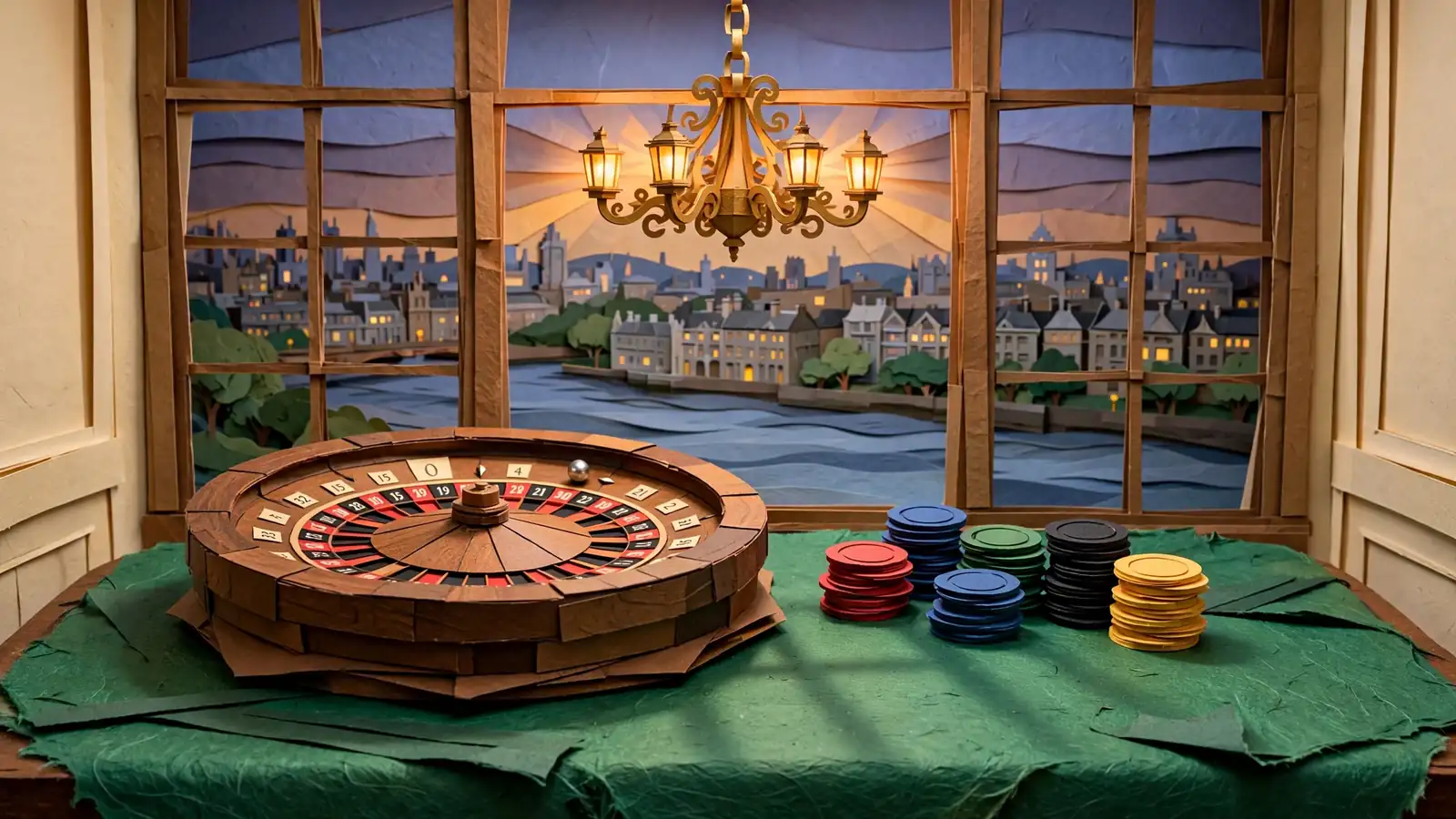
The European roulette wheel features 37 pockets, distinguishing it from the American version which includes a double zero.
For a digital game, the same idea can be represented without a physical rim or a visible ball. The essential question is not whether the wheel is made of wood, metal or animation, but whether the game reproduces the 37-pocket European arrangement. A label saying “European” should correspond to one zero and the numbered range from 1 to 36. Anything else belongs to another ruleset, however familiar the interface may look.
That distinction is especially useful when an online casino presents several roulette tiles side by side. Names can be dressed up with studio imagery, special effects or branded features, while the underlying wheel remains the decisive fact. A European roulette casino game begins with its pocket count, not its graphics. The spinning picture is theatre; the number of possible resting places is the mathematics.
The wheel is therefore both elegant and candid. Thirty-six numbered pockets suggest balance, while the lone green zero states the terms. It does not promise that outcomes will look orderly. It simply ensures that the casino’s advantage is built into the circle before the first spin begins.
Bonus Terms, Where Roulette Counts for Less
A roulette bonus can look generous until the game’s weighting is read. The headline offer may be expressed in bonus funds, while the accompanying terms decide how much each qualifying wager contributes towards the wagering requirement. Roulette is often included, but it is rarely treated as generously as some other casino games.
The important distinction is between the amount staked and the amount credited towards the requirement. A wager is not necessarily counted pound for pound. If roulette carries a 10% game weighting, only the permitted fraction of that stake is recognised for the bonus calculation. The wheel still turns in full; the bonus meter merely moves at a slower pace.
Online casinos without ID in the UK: what to know
Most UK operators place roulette wagers within a 10% to 20% weighting range. That figure may apply differently to live roulette and RNG roulette, and the wording can change between promotions. A European roulette table therefore does not have one universal bonus value simply because the wheel has a single zero. The bonus belongs to the operator’s terms, not to the wheel’s mathematics.
Live and RNG roulette are often treated differently
Live roulette is commonly given a lower weighting than RNG roulette. In material examined by a specialist review, live roulette was assigned either 10% or 20%, while RNG roulette was credited at 100%. Those figures should be treated as terms attached to particular offers, rather than as a permanent rule for every UK casino.
The distinction reflects the way operators classify games for promotional purposes. A live table with a dealer, streamed play and a physical wheel may sit in a restricted casino-games category, while a computer-generated roulette game may be placed in a fully qualifying category. From the player’s point of view, both involve the same basic red, black and numbered betting choices. From the bonus department’s point of view, they may be entirely different creatures.
That is why the game title alone is not enough. “European roulette” identifies the variant, but not the promotional weighting. The same style of roulette may appear as a live table, an RNG game or a roulette-themed product with separate terms. The bonus page, game contribution table and individual promotion rules have to be read together.
Do
- Check the UKGC public register for a valid licence
- Verify age before depositing funds
- Confirm the specific roulette weighting in bonus terms
Don’t
- Rely on logos or claims of being “licensed in the UK”
- Assume all roulette games have the same bonus contribution
- Ignore the difference between live and RNG weighting
No assumption should be made that a free-play offer will treat roulette in the same way as a deposit bonus. A specialist review has reported that some operators exclude live roulette from no-deposit bonus wagering altogether; where it is included, the stated weighting can be between 0% and 10%. This is a description of reported terms, not a general promise about every offer carrying the word “free”.
The wagering cap changes the small print
Since January 2026, UK regulations have capped bonus wagering at a maximum of 10x for all licensed operators. The cap limits the multiplier that can be attached to a bonus requirement, but it does not make every game contribute equally. A lower roulette weighting can still mean that the bonus balance advances more slowly than it would on a game with full weighting.
The two controls therefore work differently. The maximum wagering rule limits the size of the requirement itself. Game weighting determines how much of each eligible wager is recognised against it. Confusing these points produces the familiar illusion of a short route that is, in practice, paved with very small steps.
Terms may also state which roulette products qualify, whether bonus funds can be used on them, and whether a game is excluded once a promotion has been activated. Such conditions matter particularly when a player moves between a live table and an RNG version of European roulette. The name may remain almost unchanged while the contribution rate does not.
Online Bingo UK: How Rooms, Tickets and Slots Differ
A sensible reading order is therefore simple: identify the bonus requirement, find the roulette weighting, check whether live and RNG games are separated, and then note any exclusions. The advertised bonus is only the beginning of the arithmetic. The fine print keeps score.
Placing Bets and Reading the Payouts
To play European roulette online, a player first selects a table or game marked as European roulette, then chooses the amount to place on the betting layout. The interface normally presents the wheel or recent results beside a digital version of the cloth. Chips can be selected by value, placed on one or several betting areas, and removed before the betting period closes. Once the spin begins, the arrangement is fixed until the result appears.
The same basic action applies whether the game is played for real money or in a free-play mode. A real-money game uses the account balance and settles winning bets according to the displayed paytable. A free version is useful for learning the position of the betting areas and the sequence of placing and clearing chips, but it does not reproduce the financial consequences of a paid spin. The button may look reassuringly similar. The balance is not.
Inside bets and their payouts
An inside bet covers a relatively small part of the layout. The narrowest example is the straight-up bet: a chip placed on one number. If that number is selected, the bet pays 35:1 in European roulette. The ratio describes the winnings attached to the winning stake; the interface should show how the original stake is handled when the result is settled.
Straight-up Bet
Example: 35:1 × £1 stake = £35 winnings.
A split bet covers two adjacent numbers. On a digital table, the chip is placed on the line separating them rather than inside either individual number square. If either number wins, the split pays 17:1. It offers a broader target than a straight-up bet, with a correspondingly different payout.
Other inside positions cover larger groups of numbers, but the important practical point is to confirm the highlighted area before the countdown ends. Online layouts can make a chip appear to sit near a boundary while assigning it to a different bet. A brief pause to check the selected section is more useful than trusting the animation.
Outside bets and even returns
Outside bets cover broad categories rather than individual numbers. The standard choices include:
| Bet | What it covers | Payout |
|---|---|---|
| Red or black | One colour group | 1:1 |
| Even or odd | One parity group | 1:1 |
| High or low | One of the two displayed number ranges | 1:1 |
A red or black selection wins when the result belongs to the chosen colour. Even and odd work in the same plainly divided manner, while high and low divide the numbered field into two ranges shown on the table. Each of these bets pays 1:1, so the winnings match the stake under the stated payout.
The screen may offer several betting rounds in succession, allowing chips to remain in place or be cleared after each result. That is a convenience of the software, not a change to the bet. A player can repeat a layout, alter individual chips, or remove the whole arrangement before the next spin, depending on the controls provided by the game.
For a European roulette table played with real money, the decisive details are therefore visible before the spin: the selected number or group, the chip value, and the payout printed by the game. A table labelled VIP may change the setting, limits or presentation, but the bet still needs to be read in the same unglamorous way. Numbers first, theatre later.
Single Zero, La Partage and the Limits of a System
The single-zero wheel is the feature that gives European roulette its familiar mathematical character. Its pockets run from 1 to 36, with one green zero alongside them. That arrangement does not make every betting option equally attractive, but it gives the table a lower house edge than the American version: 2.70% for European roulette.
The zero is not merely another losing number on the layout. It is the pocket that prevents even-money wagers from being perfectly balanced. A red bet, for instance, covers half the numbered pockets, while black covers the other half; zero belongs to neither colour. The same interruption applies to even and odd, and to low and high bets. A result on zero defeats those outside bets.
La Partage changes what happens next. When the ball lands on zero, half of an even-money bet is returned rather than the entire stake disappearing. The rule applies to red or black, even or odd, and high or low wagers. It does not turn the bet into a fair one: the house edge on these bets falls to 1.35%, rather than vanishing altogether. The casino retains an advantage, but a smaller one.
La Partage rule
When the ball lands on zero, half of an even-money bet is returned rather than the entire stake disappearing. This rule applies to red or black, even or odd, and high or low wagers, reducing the house edge on these bets to 1.35%.
That distinction matters when comparing European roulette betting options. La Partage is tied to particular outside bets, not to the single-zero wheel as a whole. An inside bet placed on a number, pair or line does not acquire the same treatment merely because the table contains one zero. The visual closeness of the betting areas can conceal a substantial difference in how the zero affects them.
Why doubling cannot repair chance
The Martingale is often presented as a response to losing outside bets. Its rule is simple: after each loss, the next stake is doubled. A win is then supposed to recover the earlier losses and produce a small profit. The arithmetic looks persuasive only when the losing sequence is kept conveniently short.
Roulette does not remember previous spins. A run of black results does not make red more likely, and a zero does not place the next result under an obligation to compensate for it. The final outcome remains governed by chance, whether the wager is inside or outside the layout. No betting system changes the pockets on the wheel or predicts where the ball will settle.
The danger in the Martingale lies in the rising exposure. Each unsuccessful step demands a larger stake, while a losing streak can damage a bankroll before a favourable result arrives. The system therefore converts an ordinary run of losses into a rapidly expanding financial commitment. La Partage may soften the effect of zero on eligible even-money bets, but it does not make a doubling sequence safe or restore losses automatically.
A single-zero table offers a more favourable mathematical setting than many alternatives, and La Partage improves selected outside bets further. Neither feature grants control over the next spin. Chance remains stubbornly indifferent.
Live Dream Catcher Casino UK: What to Check
The Wheel on Screen: RNG, Speed and Pace
An online European roulette game does not necessarily contain a wheel at all. In an RNG version, the outcome is produced by a random number generator: software selects the result, then displays it through an animated wheel, ball, or numbered interface. The image is a representation of the game rather than a physical object determining where the ball lands.
That distinction matters less for the familiar sequence of betting and more for the rhythm of play. The software does not need a camera, a dealer, a ball drop or time for a real wheel to settle. Once a betting round closes, the result can be generated and the next round prepared almost immediately. This makes RNG roulette a practical form of online roulette for players who prefer fewer pauses between spins.
The same European format can therefore appear in two quite different ways: as a digital wheel with a green zero shown on screen, or as a game built around a streamed or automated physical wheel. The mathematics of the selected roulette variant remains the relevant point; the visual treatment does not turn an RNG game into a real-wheel table.
RNG roulette also tends to be associated with lower minimum stakes. Some games offer stakes as low as 10p, making the format accessible to a smaller bankroll and allowing a player to observe the pace without committing much money to each spin. Lower entry stakes do not make the random outcome more favourable. They alter the size of the wager, not the underlying chance.
RNG Roulette
Outcome is produced by a random number generator. It allows for faster rounds and often features lower minimum stakes.
Speed Roulette
Designed for quick rounds with shorter intervals between spins, often exceeding 150 spins per hour.
Live Roulette
Features a physical wheel and a human dealer streamed to your screen, providing a more social experience.
Speed roulette pushes the same preference for quick rounds further. It is designed to reduce the waiting that belongs to a standard table, with shorter intervals between spins and a brisker transition from one result to the next. A specialist review places speed roulette at more than 150 spins per hour, while a standard table is described at 80–100 spins per hour. Those figures are a report about the pace of particular formats, not a promise that every game carrying the word “speed” will run identically.
The difference is easy to feel in practice. At a standard table, the cycle leaves more room for hesitation, conversation or simply watching the wheel. Speed roulette treats that empty space as an inconvenience to remove. RNG play can be quicker still because the software controls the entire sequence, from the closing of bets to the presentation of the result.
Fast play has an unromantic consequence: more rounds can pass through a session before attention catches up with the clock. The screen may make the wheel look effortless. Chance remains less accommodating.
A Table Layout Built Around the Zero
The European roulette table is a diagram of the wheel translated into rows, columns and coloured spaces. Its most recognisable feature is the long field of numbers from 1 to 36, followed by a separate green zero. That arrangement reflects the wheel’s 37 pockets: the numbers 1 through 36 and one pocket that belongs to neither colour nor parity.
Online Slots Payout Percentage: What It Measures
The numbered field is arranged in three vertical columns, each containing twelve numbers. Seen from above, the layout looks orderly, even though the physical wheel places the numbers around its rim in a different sequence. The table is therefore not a map of the wheel’s actual clockwise order. It is a betting map: a compact way to gather numbers that share a row, column, colour or numerical range.
Inside the numbered field
The smallest spaces sit directly on the numbered grid. A chip placed in the centre of one number marks that number alone. Lines between neighbouring spaces indicate combinations: the edge between two numbers, for instance, belongs to both and forms a split position. The corners and other junctions extend this visual language to larger groups.
This is why the layout matters even when the wheel itself is not visible. The position of a chip shows the intended group. A mark inside a square concerns one number; a mark straddling a boundary concerns the numbers meeting at that boundary. The table communicates through geometry rather than lengthy instructions.
The three columns also create horizontal groups of three, while the full grid is divided into blocks of twelve. These sections are usually labelled beneath or beside the numbers. They allow the table to display broad numerical areas without disturbing the central numbered field.
Outside the grid
Around the numbered rectangle sit the outside betting spaces. Red and black occupy separate areas, as do even and odd. Low and high ranges appear as larger blocks, while the column and dozen sections align with the grid above them. Their placement makes the table readable at a glance: the closer a space is to the number field, the more directly it refers to a defined portion of that field.
Checking the Layout
- Confirm the game is marked as European roulette
- Select the desired chip value
- Identify the chosen betting area (inside or outside)
- Verify the expected payout for the selected bet
The zero is set apart in green, normally above the main grid. It is not folded into red or black, even or odd, low or high, a dozen or a column. Visually, this single isolated pocket is the table’s small act of honesty. The exception is impossible to overlook.
Roulette-Branded Slots and the Demo Question
A roulette game and a roulette-themed slot may share a name while belonging to entirely different families of casino games. European roulette is built around a wheel, numbered pockets and bets on where the ball will land. A slot uses reels, symbols and paylines or other combinations defined by its game design. The word “roulette” in a title does not turn one format into the other.
That distinction matters when names such as 3D European Roulette, European Roulette Gold or European Roulette Platinum appear in a catalogue. A title may describe a genuine roulette product, a slot with wheel imagery, or a branded variation whose availability depends on the operator and game provider. The title alone establishes none of those things. Casino naming has never been troubled by a little theatrical fog.
A demo version raises a separate question. “Demo” generally means play without real-money stakes, but that label does not prove that a particular game has a free-play mode. Some operators display a demo button; others show only the real-money version, and some games may not be listed at all. A page describing a European roulette demo should therefore identify the actual game and the format being demonstrated, rather than treating every roulette-branded title as interchangeable.
The same caution applies to a request for a European roulette slot demo. It may refer to:
- a conventional roulette game offered for practice play;
- a slot decorated with roulette imagery;
- a named product whose title includes European roulette;
- or a general wish to explore the theme without depositing.
These possibilities lead to different expectations. A roulette demo should reproduce the rules of the relevant wheel game, whereas a themed slot demo would present the slot’s own mechanics. Neither should be judged by its title alone.
Named products require the same restraint. Book of Dead is a slot title, but its name supplies no evidence that it is a roulette game or that a demo is available. XXXtreme Lightning Roulette is presented as a roulette product, yet a product name by itself does not confirm a free-play mode at any particular casino. Availability, presentation and access can change between operators.
For that reason, a responsible description should separate three statements: what the game is, whether it is roulette or a roulette-themed slot, and whether a demo can actually be opened. Blurring those categories makes a catalogue look fuller than it is.
Live Roulette, Real Dealers and UK Safeguards
Live dealer roulette brings the physical table into a studio and sends it to the screen. A human dealer spins a real wheel, releases an actual ball and manages the round while cameras show the action. The result is not a computer animation: the wheel, ball drop and dealer form the visible centre of the game.
UK Compliance
Only play at casinos holding a valid UKGC operating licence. A casino without a valid licence cannot legally offer real-money gambling to British residents.
That makes live European roulette online distinct from RNG roulette. An RNG table generates each result through a random number generator, without a physical wheel or dealer. Speed roulette belongs to a different category again: it is designed to move rapidly through rounds, whereas a live table leaves room for the dealer’s announcements, betting window and presentation. The distinction is about how the result is produced and how the game feels, not merely about the name displayed above the table.
Minimum stakes need careful reading rather than hopeful assumptions. A specialist review reports UK live roulette tables starting at 10p, while auto-roulette and speed formats in that account sometimes begin at 5p. Those figures describe reported table settings, not a permanent feature of every live casino. The small print remains less theatrical than the wheel, but more decisive.
For real-money play, a valid UK Gambling Commission licence is essential. A platform without one cannot legally offer live roulette to British residents. The licence should be checked on the UKGC public register before a deposit is made. UKGC-licensed live casino operators must also verify age before allowing deposits and provide controls intended to interrupt impulsive play.
Those protections include:
- a financial limit prompt before the first deposit and accessible account-level limit controls;
- deposit and loss limits;
- session-time reminders and reality checks;
- cool-off periods and GamStop self-exclusion;
- an internal complaints procedure and access to an approved Alternative Dispute Resolution service.
The safeguards apply to live tables as part of the operator’s remote gambling service, not as an optional decoration around the studio feed. A real dealer may make the room feel social; regulation still treats the account as a place where money, time and vulnerability require boundaries. The wheel is physical. The responsibility is administrative.
European and American Roulette: The Extra Zero Changes the Odds
The central difference in European roulette versus American roulette is not the colour of the felt or the shape of the table. It is the number of pockets competing for the ball.
A European wheel has 37 pockets: numbers 1 to 36 and one green zero. An American wheel adds a second green zero, so it has 38 pockets in total. That extra space does not create another winning opportunity for a number bet; it creates another losing result for most wagers. A small alteration, with a remarkably efficient effect.
On a standard European wheel, the house edge is 2.70%. On the standard American version, it rises to 5.26%. The difference is built into every spin, not produced by a particular casino’s presentation or by whether the game is streamed or generated digitally. A European roulette casino game therefore offers the less demanding mathematical format of the two, although neither wheel turns chance into a dependable income.
The American basket bet is harsher still. Covering zero, double zero and the adjoining first numbers, it carries a 7.89% house edge. Its generous-looking coverage disguises an especially poor relationship between the stake and the underlying probability. The felt can be busy; the arithmetic remains unsentimental.
There is also a variation worth identifying rather than treating as a market standard. A specialist affiliate review has reported some American tables with a third green pocket marked 000. On those tables, the stated house edge is 7.69%. That detail belongs to the particular game and its published rules, not to American roulette as a whole. The pocket count should be checked before play, especially when an online European roulette casino game is being compared with an American-branded alternative.
For a choice between the two formats, the practical dividing line is simple: one zero leaves the casino with a smaller mathematical advantage; two zeros enlarge it. The name “American” does not make the game more dramatic. It makes the odds less forgiving.
Should I play American or European roulette if I’m in the UK?
European roulette has the lower house edge: 2.70%, compared with 5.26% for American roulette. Some American tables have a third green pocket marked 000, which raises the house edge to 7.69%.
Is live dealer roulette with English-speaking dealers legal in the UK?
Yes, live dealer roulette can be offered legally by an operator with the relevant UK Gambling Commission licence. The licence requirement applies to operators serving customers in Great Britain.
What is the house edge on European roulette compared to American roulette?
European roulette has a 2.70% house edge, while American roulette has a 5.26% house edge. An American table with a 000 pocket has a 7.69% house edge.
Are real-money roulette sites in the UK safe?
Use a site operated by a company with a valid UK Gambling Commission licence, and check the operator on the Commission’s public register. Licensed operators must provide safeguards such as account limits, self-exclusion and an approved alternative dispute resolution route.
Best casino sites in the UK
- BeOnBetBonus: 100% up to €500 + 100 FS · Payout speed: 1-3 business days
- NightLuckBonus: Welcome Pack + 805% Up To 6400€ + 280 FS · Payout speed: 1-3 business days
- AmunbetBonus: Join now and get 450% up to 2,700 GBP + 450 FS · Payout speed: 1-3 business days
- JetsetspinsBonus: 200% Bonus + 100 Free Spins + Free Royal Wheel · Payout speed: 1-3 business days
- x3betBonus: Welcome Pack 100% Up to £1.000 + 200 Free Spins · Payout speed: 1-3 business days
- SpinFormulaBonus: 550% Up To £15,000 + 550 FS · Payout speed: 1-3 business days
- EvoSpinBonus: 125% up to €2500 + 125 Free Spins · Payout speed: 1-3 business days
- ChanzeBonus: Slots Welcome Bonus #1 200% up to €500 · Payout speed: 1-3 business days
- SlotoSportBonus: 500% up to £ 10 200+ 777 FS · Payout speed: 1-3 business days
- Revery PlayBonus: 100% up to€1,000+ 100 FS · Payout speed: 1-3 business days