

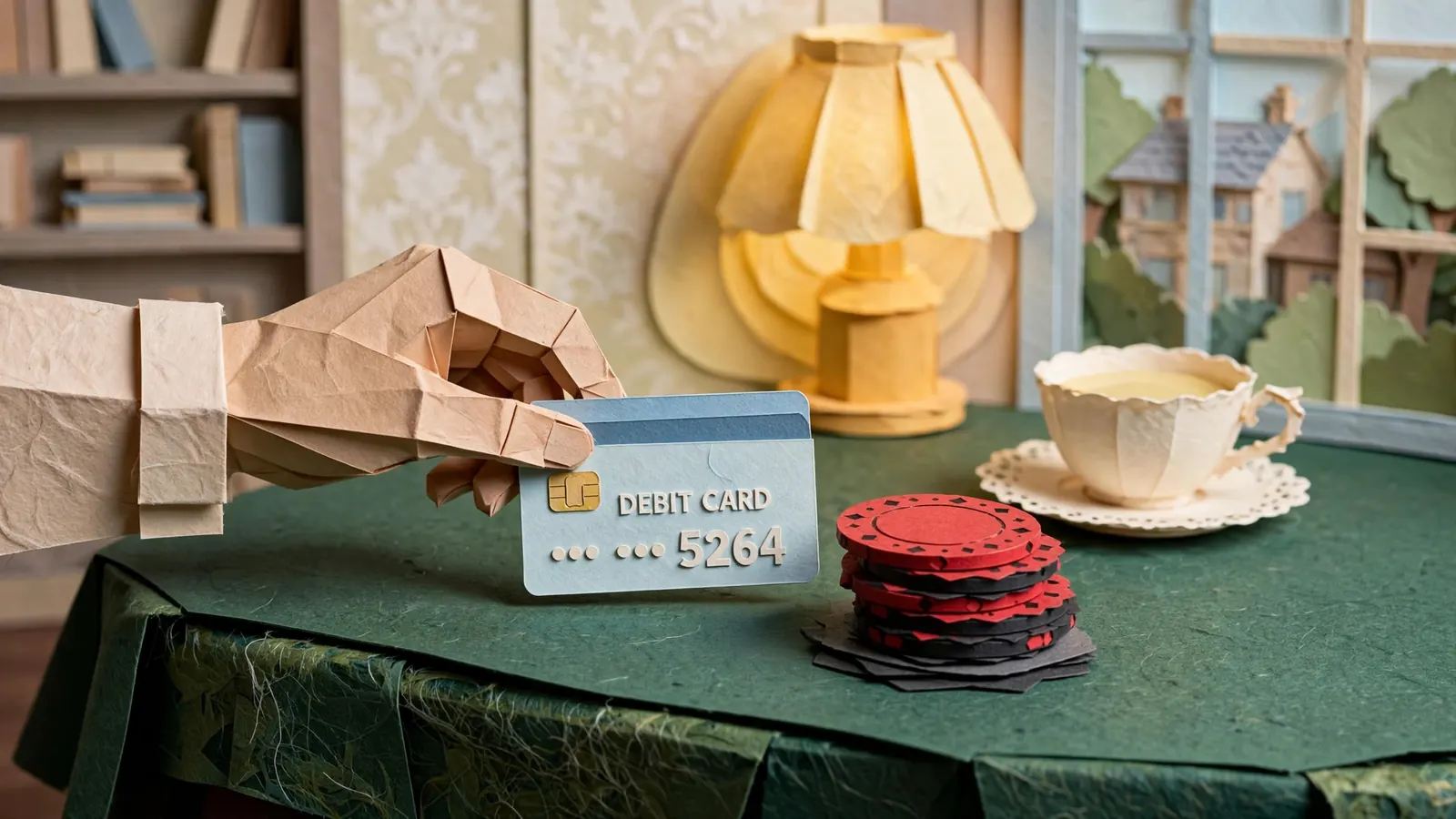
Card acceptance, deposit limits, withdrawal timing and payment rules all shape how debit cards work at UK online casinos.
Why Debit Cards Remain a Familiar Casino Payment
Debit cards occupy an unusually ordinary place in the British online casino. They are not exotic financial instruments, nor do they ask the account holder to learn a new vocabulary before making a payment. A card already used for groceries, travel and household bills becomes, in the casino cashier, one more route for moving money from a bank account into a gambling balance.
That familiarity explains much of their staying power. UK casinos commonly accept debit cards, with Visa and Mastercard among the names most often recognised. The logos are familiar before the casino appears on the screen. They belong to the visual grammar of everyday banking, which makes the payment option feel less like a special arrangement and more like an extension of an existing financial habit.
This is the basic appeal of debit-card casinos in the UK: the payment method is attached to an ordinary bank account rather than to a separate casino wallet or a newly opened financial service. The distinction matters socially as much as technically. A payment method can be perfectly functional and still feel alien; debit cards rarely have that problem. They have been absorbed into daily life so thoroughly that their presence at a casino checkout can seem almost unremarkable.
Casinos That Accept Tether in the UK: What to Check
What “accepting debit cards” means
An online casino that accepts debit-card deposits provides a card payment option in its cashier. The casino presents the relevant payment route, and the cardholder supplies the requested details through that payment process. The money then moves from the linked bank account towards the casino balance, subject to the bank, the card network and the casino’s own payment arrangements.
That description is intentionally less glamorous than the language used by casino advertising. There is no mysterious technology hidden behind the familiar plastic or digital card. The important point is that the casino has arranged to process a payment through a recognised card network. Visa and Mastercard are therefore not merely decorative marks on a page: they identify the card systems commonly used for this kind of transaction.
The presence of either logo establishes the broad payment category, not a universal promise about every card. A debit card may carry the Visa or Mastercard name while belonging to a product with its own restrictions. The cashier remains the practical setting in which a particular payment route is presented. That detail belongs to the ordinary landscape of card acceptance rather than to any claim that every card will behave identically.
Diners Club Casinos in the UK: Check the Cashier
Why the method remains visible
Payment fashions change quickly online. New wallets appear, bank-based services become more prominent and casinos adjust their cashiers to suit the routes available to them. Debit cards nevertheless retain a place because they bridge two worlds: the established banking system and the comparatively theatrical world of internet gambling.
That bridge is useful to operators as well as account holders. A casino can display a payment option that many people already understand, while the account holder does not need to maintain a separate balance with an unfamiliar provider. The card is already connected to a bank relationship, already protected by the procedures of that relationship and already recognised in ordinary commerce.
This does not make a debit card morally neutral or financially harmless. It simply explains its position in the payment landscape. The same ordinariness that makes a card easy to recognise can also make a gambling payment feel less distinct from a routine purchase. British regulation has never treated every familiar payment habit as a reason to remove it from view; instead, the legal system draws boundaries around how licensed remote gambling services operate. The payment method remains familiar, while the activity is still gambling.
Visa and Mastercard in the British market
For anyone comparing casinos that accept debit cards in the UK, Visa and Mastercard are the central names to look for. Both are commonly accepted by UK casinos, which is why they appear so often in descriptions of online casino payment facilities. Their presence gives the market a degree of continuity: a card issued by one bank can use the same broad network as a card issued by another, even though the account terms and products may differ.
That continuity should not be confused with sameness. Visa and Mastercard are networks, not the banks that issue every card carrying their marks. The issuing bank remains part of the transaction, and the casino decides which card payments it supports through its own cashier. A casino may therefore present Visa and Mastercard as accepted methods while the exact experience depends on the particular card and account.
Visa and Mastercard are payment networks, not the banks that issue the cards. The issuing bank remains part of the transaction process.
Still, the broader point survives those qualifications. Debit cards are not a marginal curiosity in British online casinos. They are a recognised part of the standard payment vocabulary, and Visa and Mastercard are the two names most readily associated with it.
Debit cards and the shape of the cashier
The cashier is where a casino’s payment landscape becomes visible. Card logos sit alongside whatever other routes the operator has chosen to make available, but debit cards often provide the most immediately intelligible starting point. They require no explanation comparable to a specialist wallet or a new banking service. The cardholder sees a known symbol and understands the general nature of the transaction.
That simplicity has cultural weight. Casino payments can otherwise make money feel abstract: balances become figures on a screen, and financial movement is hidden behind branded interfaces. A debit card pulls the transaction back towards the recognisable bank account. It is a small reminder that online gambling is not a separate economy, despite the bright colours and celebratory language.
For that reason, debit-card casinos continue to occupy a familiar place in the UK market. They are not necessarily the only payment choice a casino offers, and the logos alone do not describe every detail of a particular card product. But as a general payment category, debit cards remain established, recognisable and widely represented. Familiarity, in this case, is not a slogan. It is the infrastructure.
Best casino sites in the UK
- BeOnBetBonus: 100% up to €500 + 100 FS · Payout speed: 1-3 business days
- NightLuckBonus: Welcome Pack + 805% Up To 6400€ + 280 FS · Payout speed: 1-3 business days
- AmunbetBonus: Join now and get 450% up to 2,700 GBP + 450 FS · Payout speed: 1-3 business days
- JetsetspinsBonus: 200% Bonus + 100 Free Spins + Free Royal Wheel · Payout speed: 1-3 business days
- x3betBonus: Welcome Pack 100% Up to £1.000 + 200 Free Spins · Payout speed: 1-3 business days
- SpinFormulaBonus: 550% Up To £15,000 + 550 FS · Payout speed: 1-3 business days
- EvoSpinBonus: 125% up to €2500 + 125 Free Spins · Payout speed: 1-3 business days
- ChanzeBonus: Slots Welcome Bonus #1 200% up to €500 · Payout speed: 1-3 business days
- SlotoSportBonus: 500% up to £ 10 200+ 777 FS · Payout speed: 1-3 business days
- Revery PlayBonus: 100% up to€1,000+ 100 FS · Payout speed: 1-3 business days
Deposits, Limits and the Rules Around Them
A debit-card deposit at a UK online casino sits between two sets of controls. One belongs to the remote gambling licensee: the casino decides how much may be deposited, how often, and what limits apply to the account. The other belongs to the card issuer or payment provider, which may apply its own transaction restrictions. The amount shown in a casino cashier is therefore not necessarily the whole story.
UK Casinos That Accept Debit Cards: Payment Guide
For a player looking for an online casino with debit card payments, the first practical figure is the minimum deposit. A specialist review places the usual starting point at £10–£20, with the precise threshold depending on the selected payment method. That range is a useful indication rather than a permanent rule. A casino may set one minimum for a debit-card deposit and another for a different route, while the same payment method may be presented differently across operators.
The minimum is not a recommendation about how much should be deposited. It is simply the smallest transaction the cashier is prepared to process under its current conditions. A low entry point can make an online casino debit card deposit technically accessible, but it says nothing about the wider account limits or whether the chosen card and payment route will remain available for later transactions. Money has a habit of acquiring fine print as soon as it crosses a border.
Maximums are not one universal ceiling
Maximum deposit limits can be set in several ways. A casino may define a ceiling for a single transaction, another for the total deposited during a day, and another for the total deposited during a month. These are separate controls, not different descriptions of one limit.
The applicable maximum can also vary according to the payment method. A debit card may have a different permitted amount from an e-wallet or bank-based route. That difference can reflect the way the payment is processed, the provider’s own risk controls, or the casino’s internal configuration. A page describing top debit card online casinos cannot sensibly treat one headline maximum as a universal feature of every deposit route.
Understanding deposit limits
Maximum deposit limits can be set in several ways:
- A ceiling for a single transaction
- A daily total limit
- A monthly total limit
These limits can also vary depending on the specific payment method used.
Account status is another variable. A newly opened account may be subject to different controls from an established account, and the casino may apply limits according to the information available about that account. The maximum shown at the point of deposit is consequently more useful than a generic figure copied from a comparison page. It relates to the selected method and the particular account rather than to debit cards in the abstract.
The provider’s limit is separate again. A bank or card issuer can decline or restrict a transaction even when the casino’s own ceiling has not been reached. Conversely, a casino can refuse a deposit because its account-level limit has been reached even though the card would otherwise permit the payment. These controls operate alongside one another. Reaching one does not cancel the other.
This distinction matters for any casino online debit card arrangement. The cashier may display a permitted deposit range, while the card issuer may impose a separate restriction. A payment can therefore be within the casino’s stated maximum but still fail because of the provider’s rules. The reverse is possible too: the card may be capable of supporting a transaction that the casino will not accept under its own account controls.
The first deposit comes after a financial limit
UK Gambling Commission rules require remote gambling licensees to prompt a new customer to set a financial limit before the first deposit. This is an account-level control, not a decorative message placed beside the deposit button. It forms part of the process that must take place before funds can be added to a newly created gambling account.
Casinos That Accept Wirecard in the UK: Payment Guide
The prompt concerns the amount that may be spent through the account over the relevant period selected in the casino’s controls. The important point is that this limit belongs to the gambling account. It is not the same as the minimum deposit, and it is not the same as the maximum transaction amount permitted by a debit-card provider.
A minimum answers one question: what is the smallest deposit the casino will process? A maximum answers another: how much may be deposited under the casino’s current method and account controls? A financial limit adds a third: what spending boundary has been set for the account before the first deposit is made? Treating all three as one figure would make the payment page appear simpler than it really is.
Remote operators must also provide accessible account-level limit controls. That gives the customer a way to view and manage the relevant boundary after the account has been opened, rather than leaving the decision trapped in the first-deposit screen. The operator’s tools govern the gambling account; they do not replace the restrictions applied by a bank, card issuer or payment provider.
For an online casino debit card UK account, the order is therefore significant. The casino presents its required financial-limit prompt, the account-level control is set, and only then can the first deposit proceed. The debit card still remains subject to its own provider’s authorisation. A successful account setup does not compel a bank to approve a particular payment, just as an available card balance does not oblige a casino to accept a deposit above its account limits.
Checking the minimum, the transaction ceiling, the broader daily or monthly limits, and the account’s financial-limit controls gives a more accurate picture than looking for one supposedly standard figure. That is the less glamorous arithmetic of online slots with a debit card. It is also the part that determines whether the payment remains within both the casino’s rules and the card provider’s boundaries.
Checking card usability
- Open the casino’s cashier after signing in
- Inspect the card options in the deposit section
- Confirm the relevant Visa or Mastercard route is available
- Verify that the account currency is set to GBP
Checking Whether a Card Will Work at Checkout
A Visa or Mastercard logo can create a reassuring impression. It can also create a false one. The mark identifies a payment network, not a promise that every card carrying that mark will be accepted by every casino account. A debit card casino UK listing may display the familiar symbols while the actual cashier applies more specific conditions.
That distinction matters because payment acceptance is not a single, permanent feature. It depends on the casino’s current arrangements, the card product, and the account through which the transaction is being attempted. A card may belong to a recognised network and still fail to appear as an available option when the cashier is opened. The logo is therefore an invitation to check, not the check itself.
The cashier is the decisive place
The payment cashier is where the general claim becomes an account-specific answer. It shows which methods are available for the account at that moment, rather than repeating a broad statement made elsewhere. Visa and Mastercard may be displayed among the casino’s payment methods, but the cashier confirms whether the relevant debit-card route is currently enabled.
This is particularly important when comparing the best online casinos that accept debit card payments. “Accepts debit cards” describes a platform-level option; it does not establish that every card product will pass through the same route. A specialist review may list Visa and Mastercard among the available methods, while the live cashier remains the practical authority on current UK availability and card eligibility. Payment pages age rather quickly. Digital furniture is rarely antique, but it can still be out of date.
The useful sequence is uncomplicated:
- Open the casino’s cashier after signing in.
- Select the deposit section and inspect the card options shown there.
- Check whether the relevant Visa or Mastercard route is available for the account.
- Confirm the transaction currency before entering the payment amount.
This is not a substitute for the casino’s own payment information; it is a way of seeing how that information applies to the particular account. A general page can describe an available method, whereas the cashier indicates whether it is available here and now.
Why the card brand is not enough
Visa and Mastercard are networks rather than guarantees attached to every individual card. Their presence on a payment page should not be read as proof that all debit cards connected to those networks are interchangeable. The difference is easy to miss because the symbols are familiar and the language used around them is often broad.
For that reason, the phrase “best debit card casino sites UK” has less practical meaning than it first appears to have. The relevant question is not simply which sites print the two logos, but whether the cashier presents a usable card option for the account in question. The same principle applies to a search for the best online casino that accepts debit card payments: the live payment menu deserves more weight than a decorative row of brand marks.
The cashier also helps separate a current payment option from a historical one. Payment arrangements change, and a method mentioned in an old comparison may no longer appear in the active deposit menu. Conversely, an option may be available at one UK casino and absent at another, without either description being inconsistent. Acceptance is attached to the individual operator and its present payment setup.
Attention A card that supports rapid funding is not a guarantee of rapid access to withdrawn funds; payouts may take several business days.
Confirming the account currency
Currency deserves attention before the first transaction, even when the card itself is issued in the United Kingdom. The account should be checked to establish whether it is set to GBP. Casino pages may describe pound sterling as supported, but the account currency still needs confirmation before money is moved.
That small check helps prevent an unexpected conversion caused by a mismatch between the account and the intended payment currency. It belongs alongside card eligibility because both questions concern what the checkout will actually do, rather than what a general payment list appears to promise.
The order is therefore clear: identify the card method shown in the cashier, establish that the card product is eligible for the account, and verify that GBP is the account currency before the first transaction. A payment logo can open the conversation. Only the checkout can finish it.
A Deposit Can Be Instant; a Payout Is Another Matter
The most misleading feature of a debit-card casino deposit is that it can make money appear to move in only one direction. A card deposit may be reflected in the gambling balance almost immediately, while a withdrawal requested from that same balance can take several business days to arrive. The two transactions use the same card-shaped doorway, but they are not mirror images.
This distinction matters when comparing debit card casino sites in the UK. The deposit is designed to fund play: the casino requests the payment, the card issuer authorises it, and the balance can become available without much visible delay. For someone making a casino debit card deposit, the experience may therefore feel almost instantaneous. The quietness of the process is part of its appeal. Money goes in, the games become available, and the payment has done its social work.
Casinos That Accept Bitcoin in the UK: Payment Checks
A payout reverses the direction. The casino must send money out rather than request it in, and the receiving bank or card system must process that return. Even when a withdrawal is made back to a debit card, it should not be judged by the speed of the original debit card deposit. A card that supports rapid funding is not thereby a promise of rapid access to withdrawn funds.
A specialist review of UK casino payment methods describes this contrast plainly: a card deposit can be instant, whereas the payout may take several business days. That is a description of timing, not a guaranteed timetable for every operator, card or account. Payment arrangements change, and the cashier remains the practical record of what a particular casino currently supports.
The difference also explains why a list of top debit card casino sites in the UK cannot be assessed solely by the word “instant”. That label generally belongs to the deposit stage. It says that the balance may be credited quickly; it does not establish how soon a withdrawal will reach the bank account or card. Treating the two stages as one service is a small linguistic shortcut with rather concrete consequences.
There is a further psychological trap. A deposit is visible as a successful event: the balance changes, and the casino debit card transaction appears complete. A payout is experienced as waiting. The money has left the gambling balance, yet it may not have reached the destination. The interval feels like an interruption, although it is part of the payment’s separate journey.
Open Banking
Connects the casino payment screen directly with a bank account for authorised deposits.
Bank Transfers
A traditional route for moving money between a bank account and a remote gambling account.
Paysafecard
A prepaid voucher used for deposits only; it cannot be used to receive withdrawals.
Digital Wallets
Services like Skrill or Neteller that are often site-specific and may have different promotional rules.
This is why searches for a debit card deposit casino or casino deposits made by debit card often produce a simpler picture than the actual cash flow. Funding and withdrawing are related functions, but they should be considered independently. A method can be well suited to placing a deposit and still offer a different experience when funds are returned.
For debit card slots in the UK, the same principle applies: the speed at which a balance is funded has no bearing on the play itself or on the later movement of money away from the casino. The appealing immediacy belongs to the entrance, not necessarily the exit.
Different clocks. Different transaction.
Why Casino Withdrawals May Take Longer
A casino withdrawal to a debit card is not simply the reverse of a deposit. The payment may travel back through a different process, involving the casino’s approval team, identity checks and the payment provider’s own handling. A card can therefore make a deposit appear immediately while a debit-card casino withdrawal remains pending for longer.
The first limitation is the route itself. UK anti-money laundering controls generally require winnings to be returned to the payment source used for the deposit. This is why a casino may send funds back to the original debit card rather than allowing a completely different destination to be selected. The rule is less glamorous than the promise of a “fast withdrawal”, but it exists to keep money moving through an identifiable chain.
That does not mean every withdrawal will be returned in exactly the same way. A casino may need to divide a payout between eligible payment sources, or request another method where the original route cannot receive the funds. Such cases can involve extra checks. A withdrawal to a debit card is therefore shaped by both the casino’s payment policy and the card arrangement attached to the account.
Casinos That Accept iDEAL in the UK: Payment Guide
Approval comes before delivery
The displayed withdrawal status often covers more than the final transfer. The casino may first review the request, confirm that the account is fully verified and complete its internal approval. A first withdrawal can take longer because this is often when identity and payment ownership checks are completed.
A specialist review identifies internal approval and account verification as key influences on withdrawal speed. That distinction matters: a delay does not necessarily mean the debit-card network is slow. The request may not yet have reached the stage at which the payment provider can process it.
A casino withdrawal to a debit card UK players recognise as pending may therefore be waiting inside the operator’s system, rather than travelling between banks. Until approval is complete, comparisons based only on the word “instant” are rather optimistic.
Debit cards compared with other routes
PayPal, open banking services and debit cards connected to fast payout systems are described among the quicker withdrawal options in a specialist review. That is a comparison of possible routes, not a fixed promise. Each casino decides which services it supports, whether the account qualifies and how quickly it releases an approved payment.
PayPal can be quick once a withdrawal has been approved, while open banking may connect directly with a bank account. A debit card can also support a relatively fast withdrawal where the casino has an efficient payout arrangement for that card route. None of these labels removes the preliminary approval stage.
This is the difference between a fast payment method and a fast complete withdrawal. The method may be capable of moving funds promptly, yet the casino’s checks still determine when the transfer begins. A specialist review likewise notes that withdrawal speed depends on the operator’s internal process and on whether the player’s account is fully verified.
Do
- Ensure the name on the casino account matches the name on the debit card
- Use consistent personal details across your profile and payment methods
- Check the cashier for real-time availability of your card route
Don’t
- Assume a Visa or Mastercard logo guarantees every specific card product will work
- Rely on old comparison pages for current payment availability
- Mix different people’s cards or bank accounts for a single account
For a first debit card casino withdrawal, the quiet administrative work can be the longest part. Later requests may encounter fewer questions, but the same payment-source and verification controls remain. Fast is conditional.
When Another Payment Route Enters the Picture
A debit card is not the only way to move money between a British casino account and a bank account. The alternatives differ less by fashionable branding than by what they are allowed to do once funds need to leave the casino again. That distinction matters: a method suitable for a deposit may stop there.
Open banking and bank transfers
Open banking connects the casino payment screen with a bank account, allowing a deposit to be authorised through the account’s own banking service. Bank transfer payments take a more traditional route, with money moving between the bank account and the remote gambling account.
A specialist review describes open banking and bank transfers as methods that can support instant deposits and fast withdrawals at many sites. That description is not a guarantee for every casino with debit card facilities: availability depends on the cashier, the banking service and the account concerned. A method appearing in a general payment guide may not be present when a particular account is opened.
These routes can therefore sit alongside a debit card rather than replace it. The useful question is whether the stated method supports both directions at the selected casino. A deposit icon alone says very little about withdrawals.
Casinos That Accept Instadebit in the UK: What to Check
Paysafecard has a narrower role
Paysafecard belongs to a different category. It is a prepaid voucher intended for deposits, so it is deposit-only rather than a complete route for moving funds in both directions. That makes it a way to fund a casino balance, not a substitute for a bank account when money later needs to be withdrawn.
Its separation from ordinary banking is the point. A player considering a debit card casino list may see Paysafecard among the available logos, but the logo should not be read as evidence that the voucher can receive a payout. Payment menus are not always maps; sometimes they are merely collections of entrances.
Skrill and Neteller at selected sites
Some casinos also offer Skrill or Neteller, both established digital-wallet names in gambling payments. Their presence is site-specific, and a specialist review reports that these wallets are often excluded from promotions. That makes the payment method a separate matter from the offer attached to an account.
The practical picture is therefore varied:
- open banking may handle deposits and withdrawals where the casino supports it;
- bank transfer can provide the same two-way role, subject to the cashier’s current options;
- Paysafecard is for deposits only;
- Skrill and Neteller are available at some sites, with promotional conditions requiring separate attention.
No single route forms the universal “best casino with debit card” companion. A debit card casino site may list several alternatives, while another offers only a smaller selection. The cashier remains the working map.
Keeping the Payment Trail in One Name
A debit-card deposit sits more comfortably within the account when the casino account and the payment method belong to the same person. The name entered for the gambling account should therefore match the name attached to the debit card and the relevant bank details. This is not a matter of presentation. It gives the transaction a clear ownership trail.
A casino that accepts debit card deposits in the UK may display Visa or Mastercard among its available methods, but the practical question is not only whether the logo is present. The account holder’s details still need to align with the route used to move money. When they do, fewer basic questions arise about who supplied the funds and who should be associated with the account.
Ownership Consistency
Using a single name for both your casino account and your payment method creates a clear, reliable ownership trail.
The cleanest arrangement is often one named account used consistently for both deposit and withdrawal. Moving between several people’s cards, bank accounts or payment profiles makes an otherwise ordinary transaction harder to read. Even where the money itself is legitimate, mismatched names can create avoidable friction because ownership is no longer obvious at a glance.
This applies to searches for a casino that accepts debit card payments just as it does to a casino accepting other routes. A “best” or “top” casino that accepts debit card deposits is not made more suitable merely by offering a long payment menu. A narrower, clearly owned payment trail can be more useful than a crowded cashier filled with methods that belong to different accounts.
Consistency also means keeping the same personal details across the casino profile and payment account. A variation in names can be as simple as an abbreviated first name or a different spelling, yet it may still make the connection less immediate. The issue is not whether a particular variation will always cause difficulty; it is that matching information removes one unnecessary source of uncertainty.
This ownership-focused habit should not be confused with the formal rules governing how a casino handles a payout. Those rules determine what the remote gambling licensee may require when returning funds. The present point is more modest: a payment route in the same name as the account holder makes the basic transaction record easier to follow.
One name. One trail.
Casinos That Accept Upaycard in the UK: What to Check
A Debit-Card Deposit Does Not Guarantee Bonus Eligibility
A debit-card deposit and a casino promotion belong to two different decisions. The first concerns whether the payment route can be used to fund the account. The second concerns whether that route qualifies for a particular offer. Confusing the two is how a seemingly straightforward debit-card casino bonus becomes a small exercise in contractual reading.
A casino may accept Visa or Mastercard debit cards while applying separate conditions to its welcome bonus. The promotion may require a qualifying deposit, exclude certain payment services, or attach its own rules to the way funds are added. Acceptance of the card therefore says nothing, by itself, about eligibility for a debit-card welcome bonus in the UK.
The distinction matters across the language used by casino sites. A “debit card casino” can describe the cashier, not the offer. Likewise, a debit-card slot or debit-card casino game is simply a game funded through an accepted payment route; it does not create a special bonus category. Search labels may make the payment method sound like part of the entertainment, although the two remain separate in the terms.
PayPal illustrates the awkward middle ground. It is valued for speed and convenience, yet a specialist review may note that PayPal deposits can be excluded from bonus eligibility at particular casinos or under particular promotions. That is not a universal rule, but it is a reason to read the offer conditions rather than infer eligibility from the payment page.
The same caution applies to Skrill and Neteller. Both are available at some sites, while a specialist review may identify them as payment methods often left outside promotional campaigns. A deposit made through either wallet can therefore be accepted without counting towards a welcome offer. The cashier says “payment accepted”; the promotion may quietly say “not this one”.
Credit Card Ban
UK-licensed casinos are prohibited from accepting credit-card payments for gambling. Only debit cards are permitted.
For anyone comparing the best debit-card casino UK offers, the useful comparison is not merely the headline bonus. The payment-method clause deserves equal attention: it reveals whether the chosen route qualifies, whether the offer applies to new customers and which conditions govern the promotion. A debit card can open the door to the account without opening the door to every bonus.
The small print remains undefeated.
The Cost Is More Than a Visible Fee
The amount shown at the casino cashier is only one part of the cost of making a deposit by debit card. A casino may apply its own charge, while the payment provider can add another. The card issuer or bank may impose a fee as well, particularly when the transaction is treated differently from an ordinary domestic purchase. Network costs can also enter the calculation, even when they are not displayed as a separate line.
Currency creates another layer. A casino account may use pounds sterling while a card account is held in another currency, or a payment may pass through a service that converts the funds before they arrive. The exchange rate used for that conversion can include a spread: the difference between the underlying rate and the rate applied to the transaction. A specialist review identifies this as a cost that can exceed a visible flat fee. A small charge printed clearly on the payment screen is not necessarily the expensive part.
This is why no single method can be labelled the cheapest for every debit-card casino deposit in the UK. The result depends on the casino’s terms, the payment provider, the bank or card issuer, the currency of the account and the amount being transferred. A fee-free cashier does not make the transaction cost-free if the bank applies its own charge or the conversion rate is unfavourable.
The sensible comparison is therefore made across the whole payment chain:
- casino charges;
- payment-provider fees;
- issuer or bank fees;
- exchange-rate spread;
- network costs.
For a sterling account and a sterling card, currency conversion may not be part of the transaction. That should still be confirmed before depositing, since the account currency governs how the payment is processed. The same scrutiny applies when reviewing a debit-card deposit bonus: the advertised promotion says nothing by itself about the cost of funding the account. A bonus can decorate a transaction; it cannot erase its underlying charges.
Debit Cards, Credit Cards and the UK Gambling Ban
A debit card and a credit card may look almost identical in a wallet, but UK gambling rules treat them as entirely different payment instruments. A Visa debit card draws on money already held in the linked bank account. A Mastercard debit card follows the same basic principle. These cards can therefore appear among the payment options at UK-licensed casinos, subject to the individual cashier’s current eligibility checks.
A credit card works differently: the payment uses borrowed funds supplied by the card issuer. That distinction became a firm legal boundary for gambling transactions. The regulator’s ban on credit-card gambling took effect on 14 April 2020, and it has not been relaxed. UK-licensed casinos cannot accept credit-card payments for gambling.
Casinos That Accept USDC in the UK: What to Check
The restriction also covers credit-card funding routed through a money service business. A payment route does not become acceptable merely because another service sits between the card and the casino account. The same principle applies to wallet payments where the wallet permits credit-card funds to be used for gambling. The route may be dressed differently; the underlying source of funds remains the point.
This makes the phrase “safe debit card casino” less useful than it first appears. A debit card is not a guarantee that every transaction is suitable or available, and the word “safe” does not turn a credit card into an allowed method. The relevant dividing line is whether the payment draws on debit funds rather than credit, within the rules applying to UK-licensed gambling.
A Visa debit card casino in the UK is therefore a question of debit-card eligibility, not a back door into credit-card gambling. The distinction is narrow, but decisive.
Why can a fast-payout casino still delay my withdrawal?
A fast payout method does not skip the casino’s internal approval process. First withdrawals can take longer while verification is completed, and an account that is not fully verified may also slow payment.
Which payment methods are accepted in Great Britain?
Common options include Visa and Mastercard debit cards, PayPal, bank transfers and open banking. Some casinos also offer Skrill or Neteller, Apple Pay for deposits, and Paysafecard for deposits only; check the cashier for the options available at a particular site.
Which method has the lowest fees?
There is no universally cheapest method: costs can come from the casino, payment provider or bank, as well as currency conversion or network fees. Compare the total cost for your payment amount, including any exchange-rate spread.
Is Skrill available?
Yes, Skrill is a common deposit option at UK-friendly casino sites, though it is not offered everywhere and may be excluded from promotions. Check the casino cashier for availability.
Why must withdrawals return to the deposit method?
Returning funds to the original payment source is a common anti-fraud and anti-money-laundering control. Using a different route may mean extra verification.