

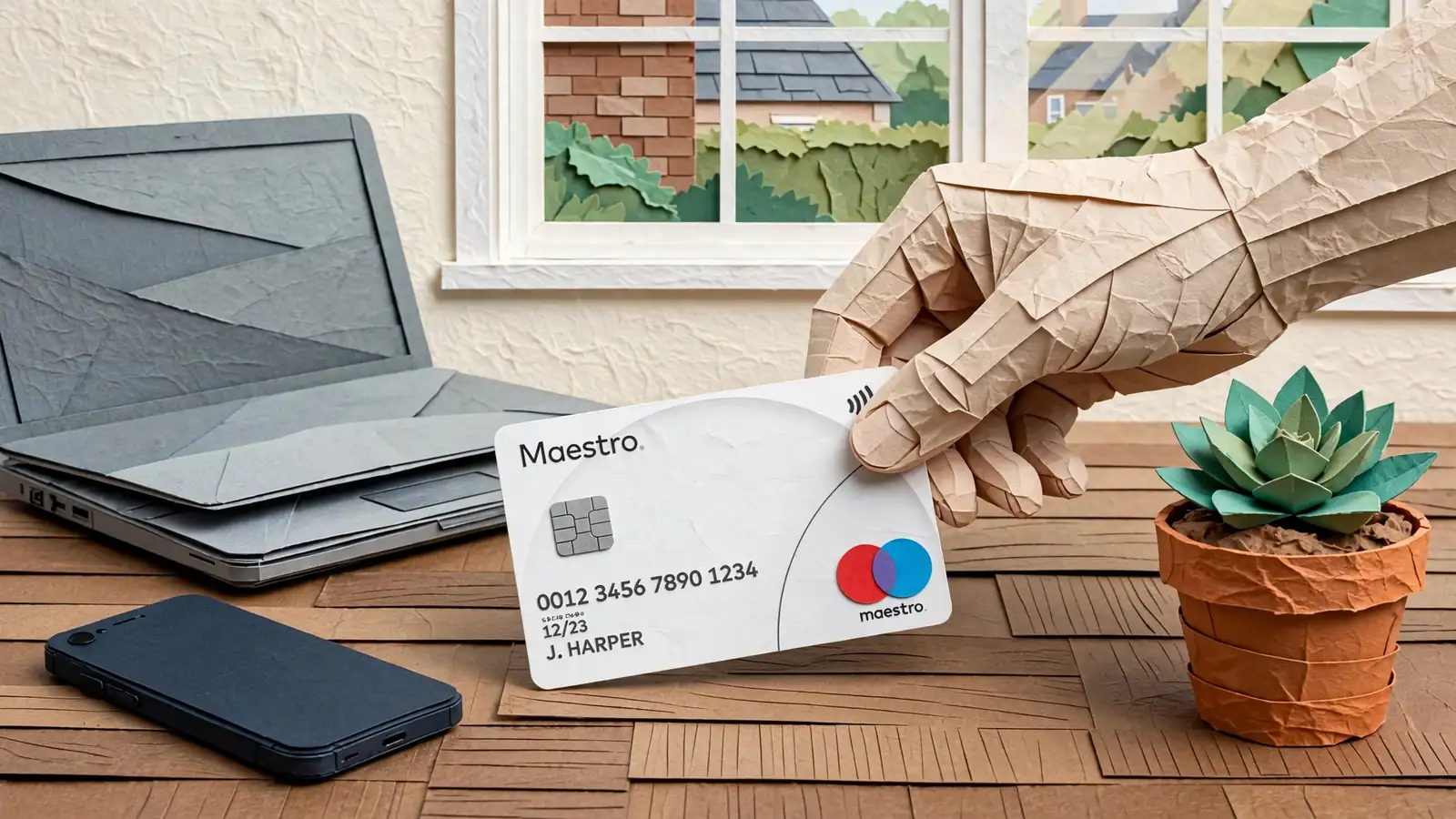
A debit-card label is not confirmation: availability depends on the casino cashier and whether the payment system accepts the transaction.
Maestro’s Place in the UK Casino Cashier
Maestro occupies an awkward position in the language of casino payments. A casino may describe its cashier as accepting debit cards, yet that broad label does not establish that every debit-card brand or card product will work. Visa and Mastercard are the familiar names in the UK market, and UK casinos commonly display them among their payment options. Maestro requires a more exact check: the cashier must show that card product as available, and the transaction must then be accepted by the payment system.
That distinction matters when looking for casinos that accept Maestro in the UK in 2026. A list of payment logos is not a permanent promise. It may describe a general payment category, a previous configuration, or a selection available only to certain accounts. Even when a page mentions Visa and Mastercard, the current cashier remains the practical reference point for card eligibility. A specialist review may list those brands as supported methods, but such a description should not be read as confirmation that every related debit card, including Maestro, is accepted at the time of deposit.
Debit cards are not one interchangeable thing
“Debit card” describes how money is taken from an account; it does not identify the network, product or processing route behind the card. A cashier can therefore accept one debit-card scheme and reject another. It can also show a card brand while applying conditions that are not visible until the payment form is opened.
Casino Payments in the UK: Methods and Deposits · Casinos That Accept MuchBetter in the UK: What to Check
For that reason, searches for all Maestro casinos in the UK can produce a misleadingly tidy answer. The useful question is not whether a casino has a debit-card icon somewhere on its website. It is whether the named casino currently presents Maestro as an available card option, accepts the particular card issued to the customer, and processes the payment in the account’s permitted currency. Those are separate points, even if a cashier compresses them into a row of logos.
The same care applies to descriptions such as “best Maestro casinos” or “new casinos accepting Maestro”. “Best” has no payment meaning by itself. It may refer to games, a welcome offer, design or editorial preference, while saying nothing decisive about whether a Maestro deposit will pass. A casino described as new may alter its cashier after launch, and an established casino may revise its payment arrangements without changing the wording on an older page. Payment availability is a live account detail, not a badge earned once and kept forever.
How to read a casino’s payment information
The first useful distinction is between a general payment page and the cashier attached to an individual account. A general page can indicate that the remote gambling licencee supports card deposits in some form. It cannot, on its own, prove that Maestro is enabled for every customer. The cashier is where the card method is presented for the account in question.
A sensible check follows a short sequence:
- Open the casino’s deposit area rather than relying solely on a marketing page.
- Look for Maestro as a named card option, not merely a generic reference to debit cards.
- Confirm that the card field accepts the relevant card details and that the transaction is being handled as a debit-card payment.
- Stop if the cashier offers only Visa or Mastercard and does not identify Maestro separately.
This is not needless pedantry. Payment systems distinguish between card networks, issuing banks and product types. A logo can signal an intended route without guaranteeing that the route is open for every card. The cashier decides more than the advertisement.
The position can also vary between a casino’s desktop and mobile presentation, or between an account that has completed its initial setup and one that has not. That does not make a mobile casino a Maestro casino. It means only that payment availability belongs to the cashier, not to the device or the general appearance of the site.
The credit-card boundary remains firm
Maestro should not be confused with credit-card gambling. The UK restriction concerns credit-card payments for gambling, and the prohibition has remained in force since 14 April 2020. UK-licensed casinos cannot accept a credit card as a gambling deposit, including where a payment arrangement attempts to route credit-card funds through another financial service.
A debit card draws on available money in a bank account; a credit card uses borrowed funds. The distinction is central to the cashier’s compliance checks. A card bearing a familiar payment brand is not automatically acceptable merely because the brand appears among the casino’s listed methods. The funding source and the product type still matter.
Credit Card Prohibition
UK-licensed casinos cannot accept credit cards for gambling deposits. This restriction has been in force since 14 April 2020.
The restriction also prevents a wallet from becoming a back door for credit-card gambling where that wallet permits credit-card funds to be used for the gambling transaction. The name of the front-end payment method does not erase the nature of the underlying funds. A cashier may therefore decline a route that appears technically possible but conflicts with the rules governing remote gambling licencees.
What “accepts Maestro” should mean
A meaningful statement that a UK casino accepts Maestro should be narrow. It should refer to a currently visible Maestro option in the relevant cashier, not to a promise inferred from the presence of debit-card logos. It should also avoid turning a past listing into a present guarantee.
This explains why claims about the best Maestro casino sites, Maestro bonuses or games should be treated separately from the card question. A promotion does not prove payment compatibility, and a casino with an extensive games catalogue may not support the particular card product. The order is simpler: establish whether the cashier recognises the card, then consider the rest.
Maestro has not vanished from the vocabulary of payment searches, but vocabulary is not authorisation. The small print is in the cashier.
Best casino sites in the UK
- BeOnBetBonus: 100% up to €500 + 100 FS · Payout speed: 1-3 business days
- NightLuckBonus: Welcome Pack + 805% Up To 6400€ + 280 FS · Payout speed: 1-3 business days
- AmunbetBonus: Join now and get 450% up to 2,700 GBP + 450 FS · Payout speed: 1-3 business days
- JetsetspinsBonus: 200% Bonus + 100 Free Spins + Free Royal Wheel · Payout speed: 1-3 business days
- x3betBonus: Welcome Pack 100% Up to £1.000 + 200 Free Spins · Payout speed: 1-3 business days
- SpinFormulaBonus: 550% Up To £15,000 + 550 FS · Payout speed: 1-3 business days
- EvoSpinBonus: 125% up to €2500 + 125 Free Spins · Payout speed: 1-3 business days
- ChanzeBonus: Slots Welcome Bonus #1 200% up to €500 · Payout speed: 1-3 business days
- SlotoSportBonus: 500% up to £ 10 200+ 777 FS · Payout speed: 1-3 business days
- Revery PlayBonus: 100% up to€1,000+ 100 FS · Payout speed: 1-3 business days
When Maestro Is Missing: Other Ways to Fund an Account
A missing Maestro logo does not leave a casino account financially stranded. It simply shifts attention from one card scheme to the architecture behind the cashier. Bank-linked payments, prepaid vouchers and e-wallets may all appear under the broad heading of “payment methods”, but they do not perform the same job. One may connect directly to a bank account, another may stop at the deposit stage, and a third may place an additional account between the player and the casino.
That distinction matters more than a tidy row of logos.
Casinos That Accept AstroPay in the UK: How to Check
Bank-linked payments
Open banking and ordinary bank transfers are the closest alternatives to a debit-card deposit in the sense that they draw on a bank relationship rather than on a separate stored-value wallet. Open banking services can connect the casino cashier with the customer’s bank, while a bank transfer moves money through the banking system using the details supplied by the remote gambling licensee.
A specialist review has described open banking and bank transfers as capable of producing instant deposits and quick withdrawals at many sites. That is a description of reported availability, not a promise attached to every cashier. The payment route, the operator and the account can all affect what appears and how the transaction is handled.
The practical attraction is structural: the money begins and ends in a bank-linked environment. Yet “bank transfer” is not a single experience. An instant open-banking payment and a manually arranged transfer belong to the same family without being identical twins. The cashier may present one, the other or neither. A casino that accepts card payments is not thereby committed to bank transfers, and a site displaying a bank-transfer option is not automatically offering open banking.
For people looking for alternatives to Maestro at UK casinos, this is therefore a separate category rather than a replacement card. It may suit an account holder who prefers a direct connection with a bank, but the method must be available at the selected cashier and usable for the intended direction of funds. Payment names are not interchangeable simply because they sit beside one another on a webpage.
Prepaid deposits
Paysafecard belongs to a different world. It is a prepaid voucher, bought in advance and then entered at the casino cashier. The casino does not receive a card number in the ordinary sense, and the payment is not a bank transfer disguised by a more modern interface.
Paysafecard Limitation
Paysafecard is a deposit-only method. While it can be used to add funds to a gambling account, it cannot be used as a route for receiving withdrawals.
Its defining limitation is equally clear: Paysafecard is deposit-only. It can place funds into a gambling account, but it is not a route for receiving a withdrawal. That makes it useful for separating a deposit from a bank card, while also making it unsuitable as a complete deposit-and-payout arrangement.
The voucher model has an old-fashioned quality, though not an entirely unhelpful one. Money is loaded before the casino sees it, and the cashier receives the voucher’s value rather than being granted access to an underlying credit facility. Still, prepaid does not mean universally accepted. A casino must display Paysafecard as an available method, and the terms attached to that method determine whether it can be used for the transaction in question.
The difference between a prepaid voucher and a bank-linked route is therefore not cosmetic. One is designed to fund the account and stop there; the other may support a broader movement of money, subject to the operator’s process. Treating both as merely “ways to pay” hides the most important practical distinction.
E-wallets
E-wallets create a third route. Skrill and Neteller hold payment functionality in a separate account, so the casino cashier communicates with the wallet rather than directly with a bank card or a voucher. They are available at some sites, not across the whole market.
UK Casinos That Accept E-Wallets: Payments Explained
A specialist review identifies Skrill as one of the more frequently encountered deposit choices at UK-friendly casino sites in 2026. That describes its presence in the market at this point in time, rather than guaranteeing that every casino accepting alternative payments will display it. Neteller occupies a similar but not identical position: it can be found at some sites, with availability decided by the individual operator.
Jeton has a narrower footprint. A specialist review places it at a handful of UK online casinos in 2026, which is enough to make it a live possibility but not a dependable substitute for Maestro across the market. The small scale is the point. A payment method can remain active without becoming common.
E-wallets also carry a qualification that does not belong in the small print merely for decoration. Skrill and Neteller are often left out of promotional eligibility, according to a specialist review. Acceptance by the cashier and qualification for an offer are separate matters; a deposit can be technically successful without satisfying the conditions of a promotion. Payment mechanics have never been particularly interested in marketing language.
Casinos That Accept Zimpler in the UK: What to Check
There is also a firm boundary around wallet funding. UK remote gambling operators cannot accept wallet payments where the wallet permits credit-card funds to be used for gambling. An e-wallet is not a loophole through which a prohibited credit-card payment can return wearing a digital hat. The source of the funds matters, not only the name shown on the cashier.
Choosing the route by its function
The sensible comparison is not “which logo looks most like Maestro?” but “what is this method built to do?” Open banking and bank transfers are bank-linked routes. Paysafecard is prepaid and deposit-only. Skrill, Neteller and Jeton are e-wallet options whose presence varies by site, with promotional treatment capable of differing from ordinary acceptance.
This also explains why lists of “best Maestro casino sites” can be misleading when they quietly substitute a collection of unrelated payment methods. A casino may accept Visa or Mastercard while omitting Maestro; another may show an e-wallet but no bank transfer; a third may support a voucher only for deposits. The cashier is a map of the operator’s actual arrangements, not a catalogue of every payment brand known to Britain.
Bank-linked payments
Includes open banking and ordinary bank transfers that draw directly on a bank relationship.
Prepaid deposits
Includes voucher models like Paysafecard, which are bought in advance and are deposit-only.
E-wallets
Includes services like Skrill, Neteller, and Jeton that hold functionality in a separate account.
For 2026, Skrill is reported by a specialist review as a common deposit choice among UK-friendly casino sites, while Jeton is reported at only a handful. Those descriptions should be read as changing market observations, not permanent features of the British gambling landscape. Payment systems move, operators revise their cashiers, and the familiar logo can disappear without ceremony.
No single alternative inherits every quality of a Maestro card. That is the useful conclusion. The route has to be judged by whether it is bank-linked, prepaid or wallet-based, and by whether the casino has made that route available for the required transaction. Convenience is a poor substitute for classification.
Checking Deposit Availability Before Paying
A payment logo is an invitation to inspect, not a promise that every card carrying that brand will pass through the cashier. This matters particularly when a casino’s general payment information names Visa or Mastercard while the intended card is a Maestro debit card. A specialist review may list those card networks as available, but current UK availability and eligibility depend on the cashier at the chosen site.
Casinos That Accept Monzo in the UK: Payment Guide
The cashier is therefore the useful authority at the moment of deposit. It shows which methods are enabled for the account, rather than which methods appear in a broad payment guide written for a wider audience. The distinction is slightly ungainly, but money has never been improved by elegance.
Start with the exact card or method
After opening the deposit area, the payment selection should be checked for the actual card product, not merely for a familiar logo. A Visa or Mastercard option does not, by itself, establish that a Maestro card can be used. Card schemes, issuing arrangements and casino payment settings can differ, and the visible brand is only one part of that arrangement.
If Maestro is not presented as an available card option, the absence should be treated as meaningful for that transaction. It is not a sound basis for entering card details into a neighbouring option and hoping that the cashier will interpret the difference generously. A method that is shown as available still has to pass the casino’s payment checks, but a method that is not shown should not be assumed to work because another debit-card network is listed.
Deposit Checklist
- Check that the actual Maestro card product is listed, not just a generic debit logo
- Confirm the account currency is set to GBP
- Verify the deposit amount meets the specific method’s minimum
- Ensure the payment is being made from a debit source
This is also where the distinction between debit and credit matters. UK-licensed casinos cannot accept credit-card payments for gambling, and remote gambling operators cannot bypass that restriction through a money service business. A debit card must genuinely be a debit product; a logo alone does not settle the question.
Confirm the account currency
The currency field deserves the same attention as the payment-method field. Specialist review pages say that GBP is supported on the supplied casino pages, yet the account currency still needs to be confirmed before the first transaction. A casino may display pounds in one part of its website while an account is configured differently, or a payment route may introduce conversion where the account settings do not match the intended transaction.
The relevant checks are simple:
- the account currency is set to GBP;
- the deposit screen displays the amount in pounds;
- the selected payment method is available for that account;
- the final confirmation does not introduce an unexpected currency conversion.
The point is not merely cosmetic. A deposit made in a different currency can involve conversion before funds reach the gambling account. Confirming the account setting first keeps the transaction in the currency intended for it.
Match the minimum to the intended deposit
The minimum deposit belongs to the selected method, not necessarily to the casino as a whole. A specialist review gives a typical starting range of £10–£20, with the exact threshold depending on the payment method. That range is a guide to the kind of figure that may appear, not permission to assume that every card or cashier uses the same minimum.
The amount shown beside the chosen method is the figure that governs the transaction. If a small planned deposit falls below it, the payment will not become acceptable merely because another method at the same casino permits a lower amount. Conversely, an amount that satisfies the displayed minimum does not remove the need to confirm the card’s eligibility or the account currency.
This makes the order of checking important: select the intended method, read its minimum, confirm GBP, and only then enter payment details. The cashier may also change its available options after an account is opened or after basic account checks are completed, so a general payment page should not replace the live deposit screen.
Before confirming
A final review can prevent several avoidable errors:
- The method shown is the actual Maestro card or chosen payment route.
- The casino permits that method for the account in question.
- The account and deposit amount are expressed in GBP.
- The displayed minimum suits the amount intended for deposit.
- The payment is made from a debit source, not a credit-card arrangement.
Only after those details agree does the deposit screen describe the transaction that is actually about to happen. Everything else is brochure language.
Mobile Play, Cashier Access and the Limits of a Card Logo
A casino that works on a phone is not automatically a casino that accepts every card shown in a payment guide. Mobile access describes the website’s interface: pages, account controls and the cashier can be opened through a mobile browser or a compatible app. It says nothing conclusive about whether a particular Maestro card will be accepted for a deposit.
That distinction matters because payment branding is broad. A specialist review may list Visa and Mastercard among the payment methods found across the sites it examines, but such a list is not proof that every card product under those brands remains eligible at every casino. Maestro belongs in the same category of detail that a general logo cannot settle. The card scheme, issuing bank, country, account currency and the casino’s current payment configuration can all matter.
The mobile cashier is therefore more informative than a row of logos elsewhere on the site. Once logged in, the payment page should show the methods available to that account and location. If Maestro is presented as a selectable card option, the cashier may request the card details and display the applicable deposit conditions. If only Visa or Mastercard appears, that is not evidence that a Maestro card can be entered under one of those labels. A familiar logo is not a universal passport.
Casinos That Accept Entropay UK: Availability Explained
This is also why “online slots with Maestro” should not be treated as a separate class of games. The games are offered by the casino; the payment method belongs to the account cashier. A phone may display the same real-money casino content as a desktop computer while offering a different payment flow, a different card prompt or a different route to the cashier. The screen is mobile. The eligibility decision is still made at account level.
The word “free” changes the question rather than solving it. A free-play area does not require a deposit in the same way as real-money play, but it cannot establish that the casino accepts Maestro for funding. Conversely, a mobile casino showing a card deposit button does not prove that a particular Maestro card will pass authorisation.
There is a useful boundary here. Mobile compatibility can be checked by opening the casino on the intended device and locating the cashier. Maestro compatibility must be checked inside that cashier, before a payment is attempted. The two checks sit next to each other but answer different questions.
Mobile Access
The mobile interface describes the website’s presentation, but payment eligibility is determined solely by the cashier.
A card logo promises recognition, not acceptance.
For a real-money deposit, the account holder’s details and the selected payment instrument should correspond. Credit-card payments for gambling are not permitted at UK-licensed casinos, and a mobile wallet cannot be used to bypass that restriction where it permits credit-card funds for gambling. A Maestro debit card is therefore not interchangeable with a credit card merely because both may be described casually as cards.
The mobile screen makes the process smaller, not simpler. The cashier remains the authority on whether the chosen Maestro product is available at that casino at that moment.
Real-Money Slots and the Journey from Deposit to Payout
Real-money slots involve two separate payment moments: putting funds into the casino account and receiving money after a withdrawal request. They are often spoken about as though they were opposite ends of one equally quick process. They are not. A payment card can move money into an account promptly, while a payout must pass through checks before it leaves.
For someone looking for slots that accept Maestro in the UK, the important distinction is between a successful deposit and an approved withdrawal. A card deposit may appear in the balance instantly. That only confirms that the cashier has accepted the transaction; it does not promise that winnings will return at the same pace. A specialist review describes card deposits as potentially instant while placing the payout over several business days. The two clocks begin at different points.
What happens after a withdrawal request
A withdrawal normally enters the casino’s internal approval process first. The remote gambling licensee may need to review the account, confirm the transaction and complete KYC before releasing the funds. This is especially relevant to a first withdrawal, when verification may still be outstanding. A specialist review notes that the initial payout can take longer for precisely this reason.
Casinos That Accept Tether in the UK: What to Check
The visible status in the cashier therefore matters. “Pending” does not necessarily mean that the payment provider has delayed the money. It may mean that the casino has not yet approved the request. Once approval is complete, the payment route has its own delivery stage. The overall time is consequently shaped by both the casino and the provider, rather than by the card logo alone.
A fully verified account removes one possible source of delay, but it does not turn every withdrawal into an immediate transfer. The same specialist review links withdrawal speed to the casino’s approval procedure and to whether account verification has been completed. That is a less glamorous explanation than a badge promising fast payouts, but it is the one that describes the journey more honestly.
Reading the timeline around slot play
The games themselves do not determine when a payment arrives. Whether the balance came from a deposit made for real-money slots, a mobile casino session or another form of play, the relevant stages remain the cashier’s acceptance, the withdrawal request, internal approval and delivery by the chosen payment route.
This also explains why phrases such as “play slots for money with Maestro” can conceal an important practical question. The card may be suitable for funding an account, yet the withdrawal stage can follow a different timetable. A balance appearing quickly is not the same as winnings being available in a bank account.
A sensible record of the transaction includes the deposit confirmation, the withdrawal status and any request for KYC documents. Those details show where the payment is in its journey without confusing a pending casino review with a failed card transaction. In payment matters, haste belongs to the deposit; patience is often assigned to the payout.
Withdrawal Timelines
Attention A successful card deposit does not guarantee that winnings will be returned at the same speed; payouts are subject to internal casino approval and provider checks.
Deposits, Withdrawals and the Original Payment Source
A deposit creates more than a balance on a casino account. It also establishes a payment trail. When a withdrawal is requested, the remote gambling licensee may need to connect the destination of the funds with the source from which the money arrived. That is why a casino may seek to return a payout to the same Maestro card or account used for the deposit, rather than treating every available destination as interchangeable.
This arrangement reflects UK anti-money laundering controls. Returning funds to the original payment source helps establish where the money came from and where it is going. It is not a promise that every Maestro deposit can be sent straight back to the card, nor does the presence of a card logo settle the matter. The cashier and the operator’s payment terms determine how the transaction is handled.
A consistent route also keeps the ownership story intelligible. The name and account details held by the casino should belong to the same person as the payment method. If a deposit is made from one customer’s account and the withdrawal is directed towards another person or an unrelated payment account, the operator may need extra evidence before releasing funds. That does not necessarily mean wrongdoing; it means that a simple transaction has acquired paperwork.
The cleanest arrangement is often one named account used for both sides of the transaction:
- the casino account is registered with the customer’s own details;
- the deposit is made through a payment route belonging to that customer;
- the withdrawal request follows the operator’s original-source or closed-loop rules;
- any alternative destination is used only where the casino permits it and the necessary ownership checks can be completed.
This is particularly relevant when people compare casinos that accept Maestro in the UK. A deposit route should not be judged only by whether money can enter the account. Its relationship with withdrawals matters too. “Direct withdrawal” may sound like a feature of the card, while the real decision can rest with the operator’s cashier, anti-fraud controls and the payment provider’s rules.
The same distinction matters when a card is described casually as a credit card. Credit-card payments for gambling are not accepted by UK-licensed casinos. A Maestro-branded product therefore needs to be identified correctly, and its deposit and withdrawal treatment confirmed through the relevant cashier rather than inferred from the brand name.
A no-deposit bonus does not create a separate shortcut around these controls. Where funds later become withdrawable, the casino can still require account and payment ownership checks. The financial trail remains part of the transaction, even when no card deposit began it.
One route, one owner.
Payment Methods and Bonus Eligibility
A payment method can be accepted by a casino cashier without making a deposit eligible for a promotion. These are separate decisions: the cashier handles the movement of funds, while the bonus terms determine whether that movement counts towards an offer. A Maestro deposit, where the selected card product is available, therefore does not automatically qualify for a welcome bonus, a slots promotion or a no-deposit offer.
The important wording is found in the promotion’s conditions rather than beside the card logo. Some offers refer to eligible deposits, named payment methods or particular account actions. A payment route may work perfectly for real-money play while being left outside the qualifying conditions. The apparent contradiction is only administrative. Money can enter the account; the promotional balance may still remain absent.
Bonus Eligibility
Accepting a payment method does not guarantee it qualifies for promotions. Always check the specific terms and conditions of a bonus, as some methods like certain e-wallets may be excluded from qualifying for offers.
PayPal illustrates the distinction. A specialist affiliate review reports that PayPal can be popular for its speed and convenience yet excluded from bonus eligibility. That is a claim about promotional treatment, not a statement that PayPal cannot be used at a particular casino. The cashier and the bonus page answer different questions, and one cannot safely stand in for the other.
The same caution applies to digital wallets. Skrill and Neteller are available at some sites, while a specialist affiliate review reports that they are often excluded from promotions. “Available” describes access to a payment channel. “Eligible” describes the rules of an offer. Confusing the two is an easy way to count on a bonus that the terms never promised.
This matters for searches involving Maestro casinos, Maestro slots and deposit bonuses. A phrase such as “welcome bonus” may describe the offer attached to an account, not a reward guaranteed by the card brand. Nor does a bonus code become valid merely because the deposit was made through an accepted card. The operator’s conditions remain decisive.
A sensible record of the transaction should therefore keep three details apart: the payment method displayed in the cashier, the amount deposited, and the promotion’s definition of a qualifying deposit. The same method may be accepted for ordinary funding but excluded from a particular campaign, while another offer may apply different conditions.
Payment acceptance is mechanical. Bonus eligibility is contractual. Small distinction, expensive to forget.
Small Deposits, Limits and the UK’s Financial Checks
A small opening deposit is not necessarily available for every card or payment route. A specialist affiliate review places the starting minimum at £10–£20, with the exact figure depending on the selected payment method. That range is a reference point rather than a promise attached to Maestro. A cashier may display a different minimum for the card product available on a particular account.
Casinos That Accept Neosurf in the UK: What to Check
This matters when a proposed deposit is below that range. A £5 Maestro deposit, for instance, should not be assumed to work simply because the amount is modest. The relevant question is whether the cashier shows Maestro as an available route and states a minimum that accommodates the intended deposit. A card logo is not a price list.
Maximums are less uniform still. They can apply per transaction, per day or per month, and may change with the payment method and the account’s status. A specialist affiliate review describes these limits as dependent on both factors. In practice, a limit attached to one cashier option says nothing reliable about another. Maestro, a bank-linked route and an e-wallet may each be governed by separate ceilings, while an account may acquire different restrictions as its status changes.
That payment-method limit is separate from the financial control required at account level. UKGC rules require a remote gambling licensee to prompt a new customer to set a financial limit before the first deposit. The same rules require accessible controls for managing limits within the account. The control is therefore not merely a small-deposit setting: it is a broader customer safeguard that sits alongside the cashier’s minimum and maximum.
The distinction is easy to lose in a payment screen. A cashier may reject an amount because it falls below the method’s minimum, even when the account’s own financial limit would permit it. Conversely, an account-level limit may restrict deposits even though the selected method accepts the amount. One concerns the mechanics of a payment route; the other concerns the customer’s chosen financial boundary.
Do
- Confirm the specific card product is available in the cashier
- Verify the account and deposit are in GBP
- Check the specific minimum for your chosen method
Don’t
- Assume a debit logo covers all card brands like Maestro
- Use a credit card for gambling deposits
- Rely on marketing pages instead of the live cashier
For anyone considering Maestro at a UK casino, the figures that matter are therefore the method minimum, the applicable maximum and the account’s own limit. They belong to different parts of the same transaction. Small does not mean simple.
Comparing the Cost of a Maestro Alternative
A payment method is not cheap merely because the cashier shows no obvious fee. The cost of a Maestro alternative depends on the complete transaction: the casino’s charge, the payment provider’s charge, any fee imposed by the card issuer or bank, the exchange rate applied, and possible network costs. A method that looks inexpensive at the deposit screen may acquire another cost elsewhere in the chain.
A specialist review of casino payments identifies five places where charges can arise:
- the casino processing the deposit or withdrawal;
- the payment provider handling the transfer;
- the issuing bank or card provider;
- the currency conversion applied to the transaction;
- the network carrying the payment.
That makes a direct comparison more useful than labels such as “free” or “low cost”. The relevant question is not whether a method has a visible charge, but what reaches the account after every applicable deduction.
Currency conversion deserves attention
GBP is the natural reference point for a UK casino account, but a payment route may still involve conversion if the account, provider or underlying card is set to another currency. The exchange rate may contain a spread: a difference between the market rate and the rate actually used for the transaction.
A specialist review notes that this spread can cost more than a clearly displayed flat fee. That is easy to miss because the amount may not appear as a separate line in the cashier. It is embedded in the rate, quietly doing the work of a fee without adopting its name.
For a fair comparison, the same transaction amount should be assessed across the available payment routes. The casino charge should be checked alongside the provider’s terms, the bank or issuer’s tariff, the applied exchange rate and any network cost. Only then can the total cost of a Maestro replacement be judged.
Casinos That Accept UKash in the UK: What to Check
There is no universal lowest-fee method. The cheapest route for one transaction may not be the cheapest for another when the currency, provider and account arrangements change. A specialist review makes the same practical point: cost must be calculated for the actual payment rather than inferred from the method’s reputation.
Cheap on the label is not cheap by arithmetic.
Maestro and Casinos Outside Gamstop: What the Evidence Can Establish
The phrase “casinos not connected to Gamstop” describes a search category, not a payment guarantee. A site may be presented in that way while its cashier offers a different selection of cards, wallets or bank-linked methods. Nothing about a platform’s alleged Gamstop position establishes that it accepts Maestro, supports Maestro deposits, or permits withdrawals through the same route.
The two questions must therefore remain separate:
- Is the remote gambling licensee authorised to serve British customers?
- Does its cashier currently display Maestro as an available payment method?
For the British market, a remote gambling licensee selling gambling to customers in England, Scotland or Wales must hold the relevant UK Gambling Commission licence. Offshore casinos sit outside that regulatory system and do not hold a UKGC licence. They may be accessible to residents, and a player does not incur a fine or criminal prosecution merely for playing at an offshore casino without a local licence. That accessibility should not be confused with British regulation. Different things.
“Not on Gamstop” is not itself a licence category, nor does it explain how a site’s status has been assessed. The reliable regulatory question is whether the operator appears on the UKGC public register with a current operating licence. British advertising rules also restrict promotion of gambling services to locally licensed operators, so descriptions of offshore sites require particular care rather than cheerful catalogue treatment.
The payment question still needs a cashier-level check. Visa and Mastercard appear among the payment methods listed by analysed casino websites, but card-product eligibility and current UK availability can change. The same caution applies to Maestro: a general reference to debit cards, or a page describing non-Gamstop casinos, cannot prove acceptance of this particular card product.
Nor does the existence of Maestro-branded slots or a “Maestro deposit” label establish anything about a casino’s relationship with Gamstop. Game names, payment logos and self-exclusion status belong to different parts of the account. Claims combining all three should be treated as marketing shorthand until the operator’s regulatory position and live cashier have been checked independently.
What is the fastest withdrawal method for UK casinos?
PayPal, open banking and debit cards linked to fast payout systems are generally among the quickest options. The casino’s approval process and whether your account is verified also affect the timing.
Why must withdrawals return to the deposit method?
Returning funds to the original payment source is a common anti-fraud and anti-money-laundering control. An alternative route may require additional verification.
Do UK casino withdrawals require verification?
Verification may be needed before a withdrawal is approved, and first withdrawals can take longer while checks are completed.
Why can a fast payout casino still delay my withdrawal?
A casino’s internal approval process can delay a payout, especially if your account is not fully verified. A card deposit may be instant even though the withdrawal takes several business days.